Tunable Cell-Sorting Device Holds Potential for Multiple Biomedical Applications
Posted on 12 Dec 2025
Isolating rare cancer cells from blood is essential for diagnosing metastasis and guiding treatment decisions, but remains technically challenging. Many existing techniques struggle to balance accuracy, throughput, and cell viability. Size-based methods such as deterministic lateral displacement are attractive, yet conventional devices are limited to a single fixed size threshold, reducing flexibility and increasing the risk of clogging. Now, researchers have developed a temperature-controlled microfluidic platform that dynamically adjusts its sorting threshold, enabling high-resolution and flexible cell separation.
This tunable deterministic lateral displacement platform, developed by researchers from the Institute of Science Tokyo (Tokyo, Japan), uses micropillars made from poly(N-isopropylacrylamide), a hydrogel that predictably expands and contracts between 20 and 40 °C. By exploiting this property, the device allows dynamic adjustment of the critical diameter used for cell separation.
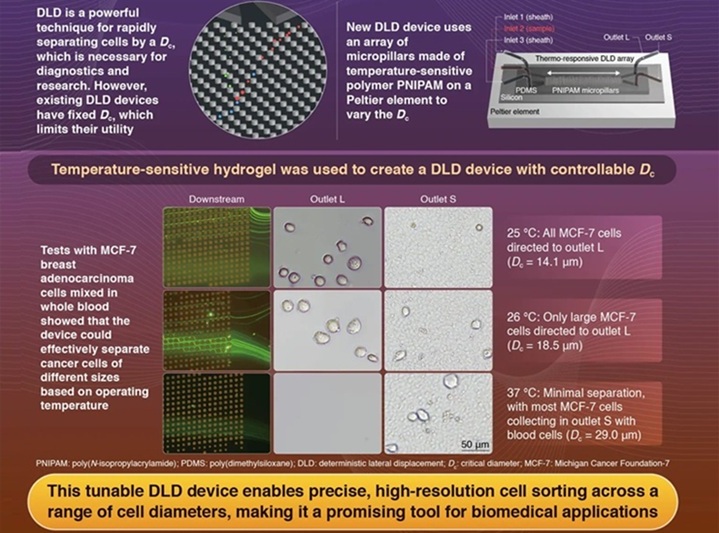
The platform integrates PNIPAM micropillar arrays within PDMS microchannels, which are bonded to a silicon substrate mounted on a Peltier element. Temperature control precisely alters pillar dimensions, enabling real-time modulation of sorting thresholds without external field-generating equipment. The use of silicon improves thermal conductivity, while taller micropillars enhance compatibility with a broad range of biological particles.
To validate its performance, the researchers tested blood samples spiked with MCF-7 breast cancer cells, which are larger than most blood cells. At lower temperatures, the system achieved about 90% sorting efficiency, directing cancer cells into the designated outlet. As the temperature increased, the critical diameter shifted, predictably changing how cells were distributed between outlets based on size.
The study findings, published in Lab on a Chip, demonstrate that the device can finely discriminate cell populations by adjusting temperature alone. This tunability also helps mitigate fouling by allowing trapped large particles to be released through dimensional changes in the array.
Going forward, the team plans to evaluate the platform using real patient samples. With its precision, versatility, and gentle handling of cells, the technology could support applications ranging from cancer diagnostics to broader biomedical and research workflows requiring high-resolution size-based cell sorting.
“The precision, versatility, and reliability of this platform underscore its potential for high-resolution size-based sorting, making it a promising tool for a wide range of biomedical applications,” said Associate Professor Takasi Nisisako, one of the research team leaders.
Related Links:
Institute of Science Tokyo