Tiny Microlaser Sensors with Supercharged Biosensing Ability to Enable Early Disease Diagnosis
Posted on 21 May 2025
Optical whispering-gallery-mode microlaser sensors function by trapping light within tiny microcavities. When target molecules bind to the cavity, they induce subtle changes in the laser’s frequency, allowing for highly sensitive biodetection. However, a significant challenge in applying these sensors in real-world situations is that coupling light into them requires a tapered optical fiber with a diameter smaller than 2 microns. These tiny fibers are difficult to align and are sensitive to environmental disturbances. This limitation has hindered the integration of microlaser sensors into lab-on-a-chip devices for real-time, high-sensitivity detection of biomolecules. In response to this challenge, researchers have developed a 3D micro-printed sensor for highly sensitive on-chip biosensing. The sensor, which is based on a polymer whispering-gallery-mode microlaser, opens up new possibilities for high-performance, cost-effective lab-on-a-chip devices aimed at early disease detection.
In their research published in the journal Optics Letters, scientists at The Hong Kong Polytechnic University (PolyU, Hong Kong, China) have introduced a new microlaser sensor design that addresses many of the difficulties in integrating these sensors into lab-on-a-chip systems, making them suitable for point-of-care medical tests. The sensor utilizes a unique Limacon-shaped disk microcavity, which enables the detection of very small concentrations of human immunoglobulin G (IgG), a common antibody found in blood and other bodily fluids. Traditional whispering-gallery-mode microlasers use circular microcavities, but this design makes it challenging to efficiently collect the emitted light, which limits the sensor's signal clarity.
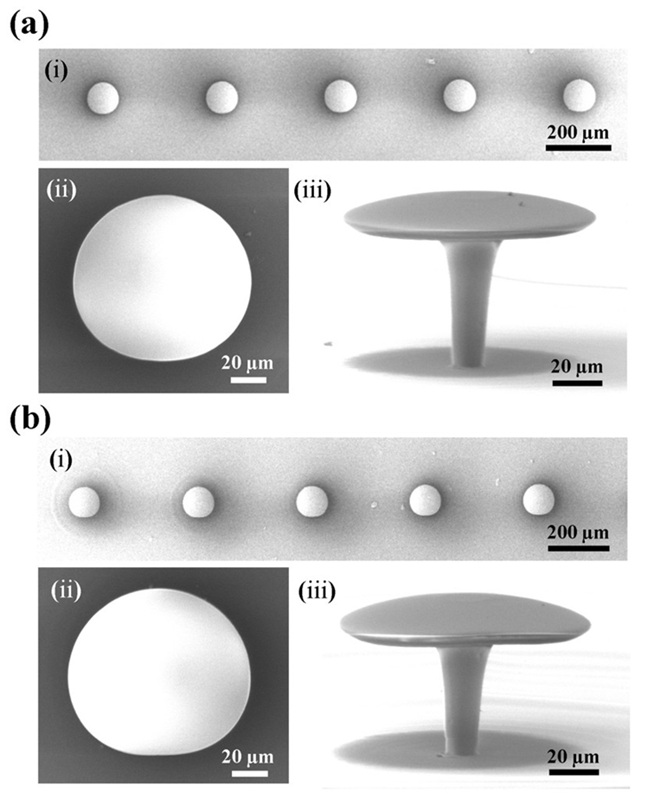
To overcome this limitation, the researchers designed a whispering-gallery-mode microlaser sensor featuring a Limacon-shaped suspended microdisk. This innovative design reduces the lasing threshold and produces directional light emission, enhancing efficiency and making it more suitable for integration into on-chip systems. Using their proprietary 3D micro-printing technology, which provides high resolution and flexibility, the researchers were able to quickly print arrays of whispering-gallery-mode microlaser biosensors. Experimental results demonstrated that the biosensors achieved a low lasing threshold of 3.87 μJ/mm2 and a narrow lasing linewidth of approximately 30 pm. Additionally, the sensors successfully detected IgG at a sensitivity level of attograms per milliliter, highlighting their potential for ultra-low detection of biomarkers for early disease diagnosis. Looking ahead, the researchers aim to integrate these microlaser sensors into a microfluidic chip to develop optofluidic biochips capable of rapidly and simultaneously detecting multiple disease biomarkers.
“In the future, these whispering-gallery-mode microlaser sensors could be integrated into a microfluidic chip to enable a new generation of lab-on-chip devices for ultrasensitive quantitative detection of multiple biomarkers,” said research team leader A. Ping Zhang from The Hong Kong Polytechnic University. “This could be used for early diagnosis of diseases such as cancers and Alzheimer's disease or for fighting major health crises, such as the COVID-19 pandemic.”
Related Links:
PolyU