Smartphone-Based Analyzer Offers Accurate Diagnostic Testing
By LabMedica International staff writers
Posted on 26 Oct 2016
Smartphone technology has been adapted to create low-cost multi-channel analyzers for accurate measurement of proteins and biomarkers for diagnostic use.Posted on 26 Oct 2016
Investigators at Washington State University (Pullman, USA) have converted a smartphone into a multi-channel optical spectral sensing device with nanometer resolution.
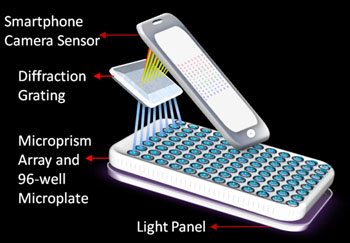
Image: Researchers have developed a low-cost, portable laboratory on a smartphone that can analyze several samples at once to catch a cancer biomarker, producing lab quality results (Photo courtesy of Washington State University).
A prototype instrument comprised a three-dimensional printed cradle that held the smartphone integrated with optical components. The multi-channel spectrometer component was built to measure the results of up to eight different ELISA tests at once.
A dedicated smartphone multi-view application was developed to control the optical sensing parameters and to align each sample to the corresponding channel. The captured images were converted to the transmission spectra in the visible wavelength range from 400 nanometers to 700 nanometers with the high resolution of 0.2521 nanometers per pixel.
The investigators used the prototype device to measure human interleukin-6 (IL-6), a known biomarker for lung, prostate, liver, breast, and epithelial cancers. The optical sensor performed accurate and reliable spectral measurements by detecting optical intensity changes at specific wavelength or optical spectral shifts. In laboratory controlled tests the smartphone device obtained results with detection limits, accuracy, and sensitivity that compared favorably to those from a standard laboratory instrument.
"With our eight channel spectrometer, we can put eight different samples to do the same test, or one sample in eight different wells to do eight different tests. This increases our device's efficiency," said senior author Dr. Lei Li, assistant professor of mechanical and materials engineering at Washington State University. "The spectrometer would be especially useful in clinics and hospitals that have a large number of samples without on-site labs, or for doctors who practice abroad or in remote areas. They cannot carry a whole lab with them. They need a portable and efficient device."
The eight channel smartphone bio-analyzer was described in the September 9, 2016, online edition of the journal Biosensors and Bioelectronics.
Related Links:
Washington State University




Platinum Member

Automated Coagulation Analyzer
Hemolumi H6
Gold Member

Quantitative POC Immunoassay Analyzer
EASY READER+
New

Gastrointestinal Panel
Xpert® GI Panel

POC Immunoassay Analyzer
Procise DX