Microcantilever-Based Sensor Detects BRAF-Mutated Malignant Melanoma
By LabMedica International staff writers
Posted on 19 Sep 2016
A novel nanosenor comprising minute cantilevers labeled with malignant melanoma-derived RNA enabled identification of patients with the BRAFV600E mutated form of the disease in less than 24 hours.Posted on 19 Sep 2016
In the United States there are more new cases of skin cancer than the combined incidence of cancers of the breast, prostate, lung, and colon each year, and malignant melanoma represents its deadliest form. About 50% of all cases of malignant melanoma are characterized by a particular mutation - BRAFV600E - in the BRAF (rapid acceleration of fibrosarcoma gene B) gene. Recently developed highly specific drugs are available to treat BRAFV600E mutated tumors but require diagnostic tools for fast and reliable mutation detection to promote successful treatment.
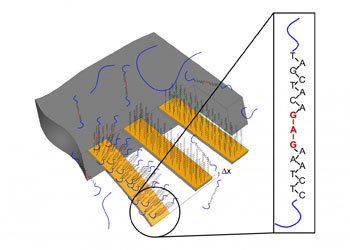
Image: The cantilever on the left bears the recognition sequence for the target mutation. If this is present in the sample being tested, the corresponding segment of RNA binds to the cantilever, causing the latter to bend. This can be measured, providing clear evidence that the genetic change is present (Photo courtesy of the University of Basel, Department of Physics).
Investigators at the University of Basel (Switzerland) and the University Hospital Basel (Switzerland) labeled nanomechanical microcantilevers with RNA from BRAFV600E mutated malignant melanoma cells.
They conducted a preliminary clinical trial in which they used RNA-labeled cantilever array sensors to demonstrate identification of a BRAFV600E single-point mutation by sampling total RNA obtained from biopsies of metastatic melanoma of diverse sources (surgical material either frozen or fixated with formalin and embedded in paraffin).
Results revealed that the method was faster than the standard Sanger or pyrosequencing methods and was comparably sensitive as next-generation sequencing. Processing time from biopsy to diagnosis took less than 24 hours and did not require PCR amplification, sequencing, and labels.
"It is essential that we are able to identify the mutations reliably in tissue samples. That is the only way of ensuring that patients get the right treatment and successful outcomes," said contributing author, Dr. Katharina Glatz professor of pathology at University Hospital Basel.
The nanosensor was described in the August 4, 2016, online edition of the journal Nano Letters.
Related Links:
University of Basel
University Hospital Basel




Platinum Member

Automated Coagulation Analyzer
Hemolumi H6


CMV CLIA Diagnostic
CLIA CMV IgA Screen Group
.jpg)
Gold Member

Clinical Chemistry Assay
Sorbitol Dehydrogenase (SDH)