Biochip Combines Graphene Electronics and DNA Strand Displacement for Detection of Polymorphism Mutations
By LabMedica International staff writers
Posted on 05 Jul 2016
A team of bioengineers has designed an electronic biochip with potential applications for personalized medicine that can detect DNA mutations caused by single nucleotide polymorphisms (SNPs) in real time.Posted on 05 Jul 2016
SNPs, which are variations of a single nucleotide base, in a gene sequence are markers for a variety of human diseases. Detection of SNPs with high specificity and sensitivity is essential for effective practical implementation of personalized medicine. However, current DNA sequencing, including SNP detection, primarily uses enzyme-based methods or fluorophore-labeled assays that are time-consuming, need laboratory-scale settings, and are expensive. Previously reported electrical charge-based SNP detectors have insufficient specificity and accuracy, limiting their effectiveness.
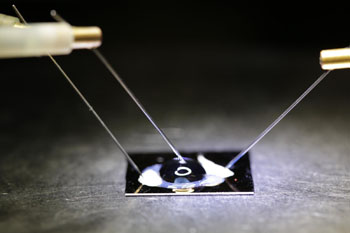
Image: The biosensor chip - consisting of a double stranded DNA probe embedded onto a graphene transistor - electronically detects DNA SNPs (Photo courtesy of the University of California, San Diego).
In an effort to improve the accuracy and specificity of SNP detection, investigators at the University of California, San Diego (USA) combined dynamic DNA nanotechnology with high resolution electronic sensing in the form of a double stranded DNA probe embedded onto a graphene field effect transistor (FET).
The detection method was based on the displacement of a weakly bound DNA double strand by one containing a specific SNP. The single mismatch was detected by measuring strand displacement-induced resistance (and hence current) change in the graphene transistor. Use of large double-helix DNA strands (up to 47 bases) improved the accuracy of SNP detection by minimizing false-positive results.
“A single stranded DNA probe does not provide this selectivity - even a DNA strand containing one mismatching nucleotide base can bind to the probe and generate false-positive results,” said senior author Dr. Ratnesh Lal, professor of bioengineering, mechanical engineering, and materials science at the University of California, San Diego. “We expected that with a longer probe, we can develop a reliable sequence-specific SNP detection chip. Indeed, we have achieved a high level of sensitivity and specificity with the technology we have developed.”
“We are at the forefront of developing a fast and inexpensive digital method to detect gene mutations at high resolution—on the scale of a single nucleotide change in a nucleic acid sequence,” said Dr. Lal.
The SNP biosensor probe was described in detail in the June 13, 2016, online edition of the journal Proceedings of the [U.S.] National Academy of Sciences.
Related Links:
University of California, San Diego




Platinum Member

Automated Coagulation Analyzer
Hemolumi H6
Gold Member

NEW PRODUCT : SILICONE WASHING MACHINE TRAY COVER WITH VICOLAB SILICONE NET VICOLAB®
REGISTRED 682.9

Hematology Consumables
Bioblood Devices


Automated Clinical Chemistry Analyzer
Envoy 500+