Microfluidic Chip Captures Live Tumor Cells from Blood
By LabMedica International staff writers
Posted on 28 Aug 2013
A neoteric microfluidic chip has been developed that can quickly and efficiently segregate and capture live circulating tumor cells (CTCs) from a patient's blood.Posted on 28 Aug 2013
The chip has potential applications for cancer screenings and treatment assessments as CTCs circulating within a patient's bloodstream can carry cancer from a primary tumor site to distant sites of the body, spreading the disease.
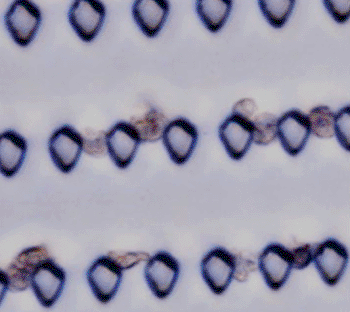
Image: Microfluidic chip capturing cancer cells (Photo courtesy of Peking University).
A team of scientists at Peking University (Beijing, China) developed the system that captures more than 90% of the CTCs, which makes it highly efficient. Overall processing time has also been shortened, due in part to a step in which red blood cells are selectively lysed, or broken apart. Lysing the red blood cells diminishes the tendency of blood to clog the system, a common problem that slows processing time in similar CTC filtering devices.
The microfluidic system consists of the chip itself, tubing, fluid connectors, syringes, and syringe pumps. Tubes and fluid connectors are used to connect the syringes, and fluidic ports punched into the microfluidic chip. The ability to count live, individual CTCs in the bloodstream can help doctors determine the severity of a cancer, since CTC density in the blood is linked to the progression of the disease and patients' likelihood of survival. The novel method could also improve "liquid biopsy" techniques, in which a small amount of blood is drawn as an alternative to conventional tissue biopsies of primary or metastatic tumors.
Ray P.S. Han, PhD, a professor and lead author, said, “Because our chip is able to capture viable CTCs, it creates opportunities for the development of new and efficient cancer biomarkers. It also gives us a chance of the grandest dream of all: a technology capable of directly removing CTCs from the human bloodstream, a form of CTC dialysis." The study was published online on June 6, 2013, in the journal Biomicrofluidics.
Related Links:
Peking University




Platinum Member

Automated Coagulation Analyzer
Hemolumi H6
Gold Member

Aspiration System
VACUSAFE

New
Silver Member

Connectivity Solution
EKF Link

Automated Urinalysis Solution
UN-9000