Study Shows How Genome Reference Bias Can Mislead Preventive Testing
Posted on 13 Oct 2026
Whole-genome sequencing is expected to play a growing role in preventive and predictive medicine, but accurate interpretation remains a major diagnostic challenge. The approach requires comparing billions of DNA letters against a reference sequence to identify variants that may indicate disease susceptibility. When that reference does not adequately represent human genetic diversity, automated analysis can generate misleading findings. Addressing this limitation, new findings demonstrate how reference bias may affect preventive genomics and point to graph-based pangenomics as a potential solution.
Semmelweis University (Budapest, Hungary) researchers evaluated the limitations of GRCh38, the widely used international reference sequence for the human genome. Whole-genome sequencing reads the nearly complete genetic “text” of a person, including more than six billion DNA letters, about 40,000 genes, and regions that regulate gene function. In current workflows, automated software compares a person’s genome with the reference to flag variants that may be medically relevant.
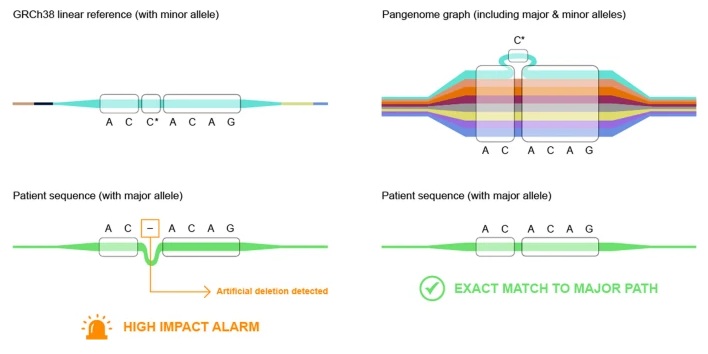
The study, published in GeroScience, compared the whole genomes of 20 healthy Hungarians with GRCh38. In all 20 cases, automated analysis identified the same severe genetic variant. Expert curation using additional, representative regions later showed that the finding was erroneous, and none of the individuals had a true medically relevant variant. The researchers described this as an important bioinformatics vulnerability.
The issue relates to the structure of GRCh38, which is based on a single linear reference coordinate system. Although it includes genetic data from multiple individuals, 70% of the data comes from the genome of a male from Buffalo, New York. The researchers said a graph-based pan-genome could provide a richer mapping system that better reflects human genetic diversity. Such a pan-genome graph already exists, but routine clinical use has not yet been realized.
“The whole genomes of 20 healthy Hungarians were compared with the GRCh38 reference genome. In all 20 cases, the automated analysis identified the same severe genetic variant, which was later found to be erroneous following expert curation based on additional, representative regions. In other words, none of them had a true medically relevant variant. The study thus demonstrates an important bioinformatics vulnerability,” said Dr. Balázs Győrffy, head of the Department of Bioinformatics at Semmelweis University and the other lead author of the paper.
“The key question for the future is to what extent information technology will be able to keep pace with advances in medicine. Current everyday IT systems simply cannot support the daily use of such massive databases,” added Dr. Győrffy.
Related Links
Semmelweis University