Rapid Blood Testing Method Aids Safer Decision-Making in Drug-Related Emergencies
Posted on 12 Feb 2026
Acute recreational drug toxicity is a frequent reason for emergency department visits, yet clinicians rarely have access to confirmatory toxicology results in real time. Instead, treatment decisions are often based on patient self-reporting and clinical symptoms, which can be unreliable when patients are confused, sedated, or unaware of what substances they have taken. Researchers have now shown that a rapid blood testing approach could deliver accurate drug identification within minutes, potentially transforming emergency care decision-making.
Researchers at King’s College London (London, UK) evaluated whether paper spray ionization mass spectrometry (PSI-MS), a laboratory technique that detects drugs directly from dried blood spots on paper, could be adapted for faster clinical use. Unlike conventional toxicology workflows, PSI-MS eliminates lengthy sample preparation and complex laboratory processing by analyzing a small drop of blood dried onto paper.
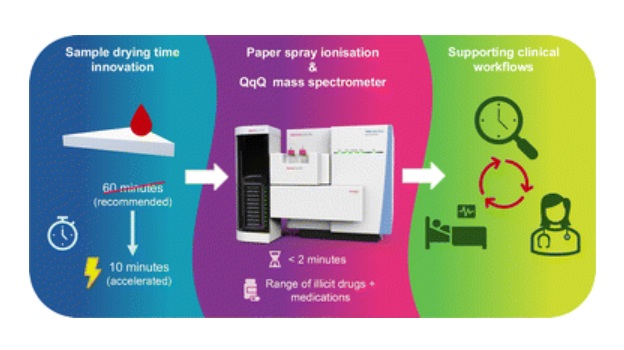
Until now, PSI-MS required blood samples to dry for at least 60 minutes before analysis, limiting its usefulness in urgent settings. The team investigated whether significantly shorter drying times could still deliver reliable and reproducible results suitable for emergency department use. Researchers tested whole blood samples spiked with ten commonly abused drugs and compared drying times of 10, 20, 40, and 60 minutes.
All samples were analyzed using PSI-MS and assessed for accuracy, precision, and consistency. Blood spots dried for just 10 minutes performed as well as those dried for a full hour, with reliable detection across all drugs tested. Shortened drying times did not affect the performance of the mass spectrometry equipment. The results, published in Analyst, demonstrate that confirmatory toxicology testing could potentially be completed within approximately 15 minutes of blood collection.
Rapid access to reliable drug identification could allow clinicians to tailor treatment more precisely, reduce diagnostic uncertainty, and improve patient safety in drug-related emergencies. Compared with the current gold standard of liquid chromatography–tandem mass spectrometry, PSI-MS is faster, simpler, and does not require specialized laboratory infrastructure or additional reagents.
While further validation is required before clinical implementation, the findings point toward a practical pathway for integrating rapid toxicology testing into emergency departments. Future research will focus on expanding drug panels and assessing real-world clinical performance.
“In drug-related emergencies, clinicians are often forced to act with limited or unreliable information,” said Vincenzo Abbate, PhD, senior author of the study. “Our results show that rapid mass spectrometry testing could provide dependable drug identification in a clinically meaningful timeframe, with clear potential to improve patient safety in acute settings.”
Related Links:
King’s College London