AI System Analyzes Routine Pathology Slides to Predict Cancer Outcomes
Posted on 06 May 2026
The digital transformation of pathology is expanding how cancers are evaluated in routine practice. Artificial intelligence (AI) is increasingly applied to routinely collected histological tissue sections, yet many approaches face limits in interpretability and transferability to new questions. Unlocking hidden biological information from standard pathology slides could improve diagnosis and help guide treatment selection. New findings now describe an agent-based framework designed to extract clinically meaningful signals from pathology images.
At University Hospital Cologne’s Department of Pathology (Cologne, Germany), researchers developed SPARK (System of Pathology Agents for Research and Knowledge), an agentic AIplatform for cancer pathology. The system links multiple specialized algorithms into a coordinated “digital brain” that autonomously generates biological hypotheses, refines them, and converts them into analytical tools without retraining underlying models. Language serves as a universal interface, enabling flexible interaction with complex image data and simple language-based analyses, such as estimating the likelihood of response to immunotherapy.
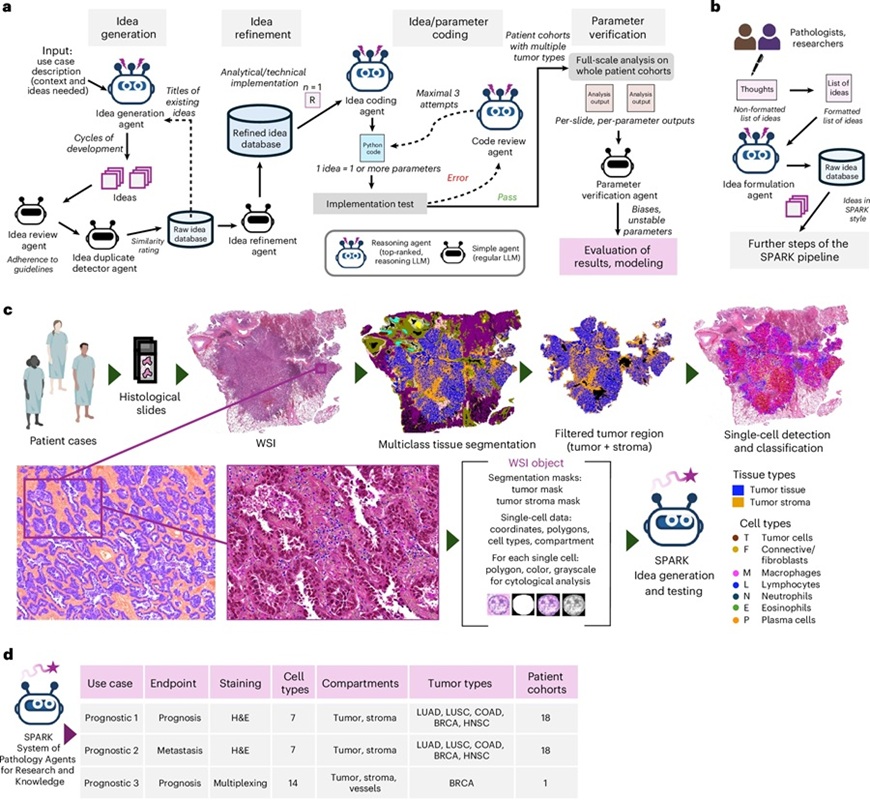
In analyses across more than 5,400 patients from 18 independent cohorts encompassing five tumor types, SPARK identified tissue markers described as both clinically relevant and biologically grounded. These markers were closely associated with disease course, established pathological parameters, and treatment response. The approach also inferred elements of temporal tumor development from static sections, offering insights into mechanisms of tumor progression.
According to the team, SPARK includes a specialized, interactive modular user interface that allows clinicians and researchers to develop analytical approaches without programming expertise. While results are promising, prospective validation in routine clinical practice is still required to confirm the technology’s benefits. Methods, parameters, and results produced with the framework have been made openly available to encourage further academic development.
The study, “An agentic framework for autonomous scientific discovery in cancer pathology,” was published in Nature Medicine The authors state that the framework can help refine diagnoses, stratify patients more reliably, and support more precise treatment decisions, particularly within personalized oncology. They also envision pathology evolving from a primarily descriptive discipline toward a more data-driven, predictive science aligned with precision oncology.
“SPARK helps to refine diagnoses, stratify patients more reliably, and make more precise treatment decisions. Particularly in the field of personalized oncology, there is an opportunity to tailor treatments more closely to the individual biological characteristics of a tumor, thereby improving treatment outcomes,” said Yuri Tolkach, Senior Physician at the Institute of Pathology at University Hospital Cologne.
"With SPARK, we aim to transform pathology from a primarily descriptive discipline into a data-driven, predictive science—and thereby make a significant contribution to precision medicine in oncology," says Professor Dr. Reinhard Büttner, Director of the Institute of General Pathology and Pathological Anatomy.
Related Links
University Hospital Cologne