New X-Ray Method Promises Advances in Histology
Posted on 28 Jan 2026
Histological tissue analysis is a cornerstone of medical diagnostics, allowing doctors to identify tumors and other pathological changes using stained tissue slices viewed under a microscope. However, this process is labor-intensive, destructive, and limited to two-dimensional views that break the tissue’s natural spatial context. Researchers have now developed a non-destructive approach that combines classical histological dyes with 3D X-ray imaging, enabling tissue and dye to be visualized and quantified separately throughout an intact sample.
In research led by Helmholtz-Zentrum Hereon (Geesthacht, Germany), along with international collaborators, the team developed a virtual histology technique that merges high-resolution X-ray computed tomography with a phase-contrast imaging method and a novel evaluation algorithm. The system simultaneously measures how tissue absorbs X-rays and how it refracts them using a fine grid placed in the X-ray beam. By combining these two signals, the algorithm reconstructs two separate three-dimensional datasets: one showing only the tissue structure and the other showing only the histological dye.
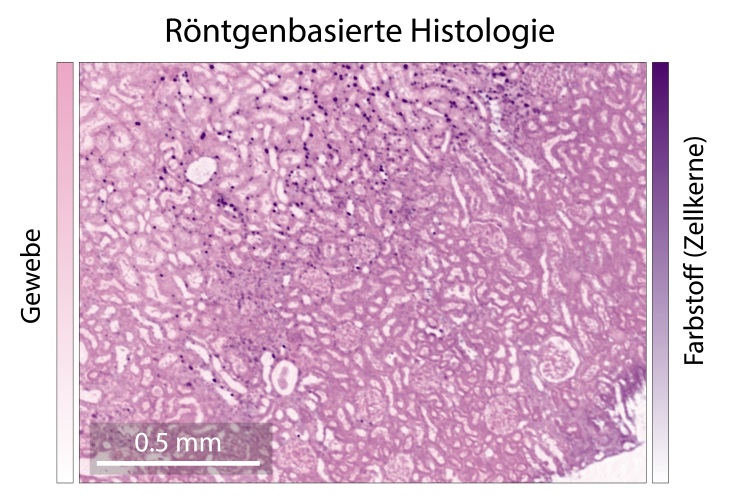
To demonstrate the method, the researchers examined kidney tissue from mice and rats stained with hematein, a dye modified with a lead atom to enhance X-ray contrast. Experiments were conducted at the PETRA III X-ray source in Hamburg and the Australian Synchrotron in Melbourne. The study, published in Advanced Science, showed that the technique not only maps dye distribution in 3D but also quantifies dye concentration in individual tissue regions. Comparisons with conventional histological sections from the same samples revealed strong agreement.
This approach preserves the full spatial context of tissue, making it possible to follow structures such as blood vessels or tumor boundaries in three dimensions. It could support research in cancer biology, organ pathology, and treatment response assessment by allowing any region of interest to be examined from any angle. While the method currently relies on large-scale synchrotron facilities, the team aims to adapt it for advanced laboratory X-ray sources. With improved resolution, the technology could become relevant for clinical diagnostics, offering more precise assessments of tumor spread and surgical completeness.
“Initially, it could serve as a tool for scientific studies, for example in cancer research,” said Dominik John, first author of the study. “But if we can find a way to improve the resolution further, it would also become highly relevant for clinical diagnostics.”
Related Links:
Helmholtz-Zentrum Hereon