High-Sensitivity Molecular Detection System Used in Cancer Screening
By LabMedica International staff writers
Posted on 04 Jan 2016
The current go-to method for reliable cancer diagnosis is tumor tissue biopsy, but this method is invasive, painful and expensive and it also only provides information of a single point in the evolution of the disease.Posted on 04 Jan 2016
A technology has been developed for a high-sensitivity molecular detection system for use in cancer screening. It is based on a technique known as liquid biopsy: the analysis of small fluid samples, like blood or saliva, making it completely noninvasive.
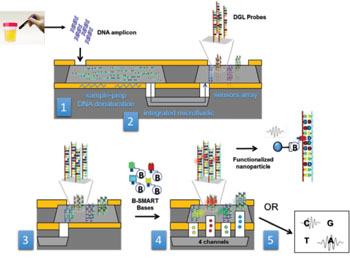
Image: Schematic diagram of the Liquid Biopsy platform LiqBiopSens concept (Photo courtesy of AWSensors).
The novel technology is fast, giving results within the hour and when combined with genomic analysis, it will be possible to obtain reliable early diagnoses and devise precision therapy approaches to cancer treatment. The new detection system will incorporate quartz microsensor technology patented by the Polytechnic University of Valencia (UPV; Spain) that allows real-time analysis, combined with technology that can reliably detect DNA mutations.
Technology developed at AWSensors (Valencia, Spain) and DestiNA Genomics, Ltd., Edinburgh. UK) will be used to advance this new system. By detecting both the DNA released by the tumor into the body and any cancer-associated mutations it undergoes, it will reliably detect the presence and evolution of the cancer, eliminating false positives.
The new system also has the advantage of being up to three times cheaper than other real-time methods, such as quantitative polymerase chain reaction (PCR), and can be carried out by non-specialists. The system called LiqBiopSens will therefore enable simple, inexpensive, noninvasive screening for early detection and periodic monitoring of tumors. The new system will be tested on the blood samples of colorectal cancer patients over the next three years. This cancer is the second cause of death in Europe and one of the most common, alongside breast, lung and prostate cancers.
Related Links:
Polytechnic University of Valencia
AWSensors
DestiNA Genomics




Platinum Member

Automated Coagulation Analyzer
Hemolumi H6
Gold Member

NEW PRODUCT : SILICONE WASHING MACHINE TRAY COVER WITH VICOLAB SILICONE NET VICOLAB®
REGISTRED 682.9
Gold Member

Blood-Based Protein Biomarker Solution for Alzheimer's Disease
BG-DTi2000.
New

Gastrointestinal Panel
Xpert® GI Panel