Blood Test Replaces Surgery for Bowel Cancer Tumor Determination
By LabMedica International staff writers
Posted on 02 Apr 2015
A blood test has been developed that could spare patients the stress of having tissue removed via biopsies for cancer diagnosis and to make the targeted use of therapy easier.Posted on 02 Apr 2015
An assessment has been made of patients with metastasized bowel cancer to determine whether it is possible to characterize tumor and better control resistance mechanisms with a diagnostic blood test.
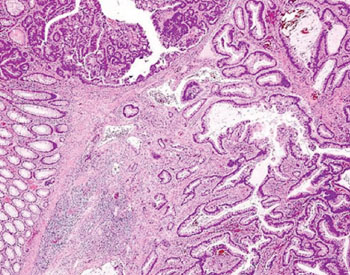
Image: Histologic section of a colonic adenoma containing invasive carcinoma (Photo courtesy of Dr. Mauro Risio).
Scientists at the Medical University of Vienna (Austria) are now commencing a study which involves patients with metastasized bowel cancer who are undergoing a new diagnostic method, namely liquid biopsy in the form of a blood test. The aim of this new method is to spot a tumor's development of resistance early on and therefore adjust the treatment quickly and in a targeted manner.
Liquid biopsies utilize the fact that tumors and their metastases excrete tumor cells and fragments of tumor DNA, which then circulate in the blood. Since blood samples are usually not stressful for patients, and they are also easier, faster and cheaper to carry out than tissue biopsies, the establishment of liquid biopsies as the standard method would represent a milestone in the diagnosis of progression and therefore treatment of metastasized bowel cancer. The new clinical study, which bears the name CRC-RELY (Colorectal Cancer Regorefanib Liquid Biopsy), is a multicenter project led by the Medical University of Vienna and is receiving active input from other hospitals in Austria, Italy, and Switzerland.
Gerald Prager, MD, a professor and specialist in internal medicine, said, “On treatment, tumors often change their biological characteristics. This allows them to develop resistance to the treatment being given. To detect these changes and in order to be able to respond to them with medications, regular samples of tumor tissue or biopsies would be needed. These are taken, for example, as part of small operations or during computerized tomography (CT) scans, however they are associated with a risk for the patient and they are stressful. With this clinical study, we are one of the first organizations worldwide to address the establishment of this diagnostic method.”
Related Links:
Medical University of Vienna




Platinum Member

Automated Coagulation Analyzer
Hemolumi H6

Gold Member

Neonatal Heel Incision Device
Tenderfoot
New

Gastrointestinal Panel
Xpert® GI Panel

Hematology Consumables
Bioblood Devices