Melanoma Development Linked to Relationship Between Pigment Synthesis and Mitochondrial Function
By LabMedica International staff writers
Posted on 12 Jan 2015
Development of melanoma, a potentially fatal type of skin cancer, is linked to the direct relationship between pigment production (melanogenesis) and generation of reactive oxygen species (ROS) by the mitochondria.Posted on 12 Jan 2015
Melanogenesis is a highly conserved process in many species that protects cells from UV radiation damage. Although both mitochondrial function and UV radiation damage are well-documented promoters of increased cellular stress, their individual molecular relationships with skin pigmentation have not been clearly resolved.
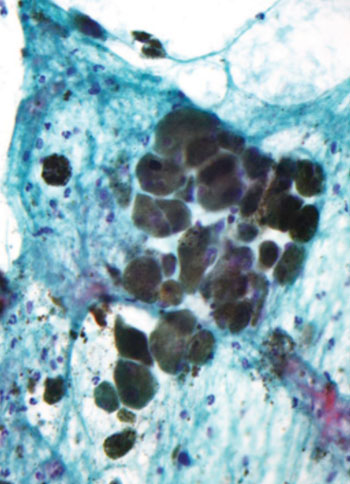
Image: Melanin pigment (light refracting granular material - center of image) in a pigmented melanoma (Photo courtesy of Wikimedia Commons).
Investigators at the University of Newcastle (United Kingdom) presented evidence for a direct relationship between cellular melanin content, superoxide flux, and mitochondrial function at Complex II. They examined three types of melanoma skin cancer cell lines that displayed low, medium, or high pigment levels and analyzed their ROS levels and mitochondrial Complex II function.
Results showed that the darker the cells, the higher ROS generation and Complex II function. When cells with lower melanin levels were induced to produce more by augmenting them with L-tyrosine, a building block for melanin production, these cell types gradually exhibited higher pigment levels, while simultaneously showing increased Complex II function.
"This study reports a novel correlation between proteins involved in the bioenergy process within the human skin (i.e., Complex II) and skin pigmentation," said Dr. Mark Birch-Machin, professor of molecular dermatology at Newcastle University. "This leads to interesting possibilities of Complex II playing a central role in coupling stress sensing and cellular adaptation via ROS signaling, and as this study was performed in skin cancer cells, may help in the development of anticancer drugs."
The study was published in the January 2015 issue of the FASEB Journal.
Related Links:
University of Newcastle




Platinum Member

Automated Coagulation Analyzer
Hemolumi H6
Gold Member

Aspiration System
VACUSAFE

HPV Test
Allplex HPV28 Detection


Automated Clinical Chemistry Analyzer
Envoy 500+