Multigene Assay Predicts Cancer Patient's Survival
By LabMedica International staff writers
Posted on 19 Aug 2014
Patients with clear cell renal cell carcinoma (ccRCC) have divergent survival outcomes and therapeutic responses, which may be determined by underlying molecular diversity.Posted on 19 Aug 2014
A practical molecular assay has been developed that can identify subtypes with differential prognosis and response to targeted therapy and predict treatment and survival outcomes in kidney cancer patients.
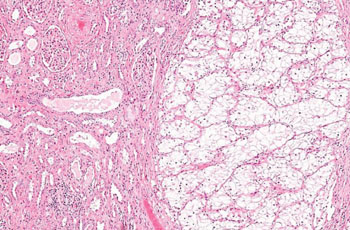
Image: Histopathology of clear cell renal cell carcinoma (Photo courtesy of Nephron).
Scientists at the Institute of Bioengineering and Nanotechnology (Republic of Singapore) and their colleagues conducted a retrospective study with a cohort of 279 ccRCC patients who underwent surgery at Singapore General Hospital (Republic of Singapore) between 1999 and 2012. They developed a practical expression-based assay with utility in formalin-fixed paraffin-embedded (FFPE) material that assigns biologic subtypes of ccRCC, characterized by differential prognosis and treatment response.
Ribonucleic acid (RNA) was extracted from a set of 55 FFPE samples (SGH-55) and processed for whole-genome expression analysis by Whole Genome (WG)-DASL (Illumina; San Diego, CA, USA). Quantitative polymerase chain reaction (qPCR) assays were designed for measuring expression in FFPE tissue; expression data for potential prognostic and normalization genes for SGH-55 were collected. A model assigning prognostic subtype was developed based on the combination of qPCR expression values of eight genes: chemokine (C-X-C motif) ligand 5 (CXCL5), ephrin A5 (EFNA5), endomucin (EMCN), laminin beta3 (LAMB3), plasminogen (PLG), preferentially expressed antigen in melanoma (PRAME), retinoic acid receptor responder (tazarotene induced) 1 (RARRES1), and solute carrier family 6 (neutral amino acid transporter), member 19 (SLC6A19).
Min-Han Tan, MBBS, PhD, the senior author of the study, said, “Our diagnostic assay successfully classified ccRCC into groups that correlated to different survival and treatment outcomes. This allows patients and doctors to make more educated choices in their treatment options. Outcomes can be very different. Some patients can be observed for years on end, some benefit from immediate treatment including surgery or targeted therapy, and for some patients, treatment can be futile. Experience is required in making the right judgment for patients. We hope our assay will play a role in helping that judgment.” The study was published on July 10, 2014, in the journal European Urology.
Related Links:
Institute of Bioengineering and Nanotechnology
Singapore General Hospital
Illumina




Platinum Member

Automated Coagulation Analyzer
Hemolumi H6
Gold Member

Quantitative POC Immunoassay Analyzer
EASY READER+
New

Neurofilament Light Chain Assay
Lumipulse G NfL Blood

CMV CLIA Diagnostic
CLIA CMV IgA Screen Group