Gene Predicts Prognosis of Breast Cancer Patients Treatment Response
By LabMedica International staff writers
Posted on 08 May 2014
A gene has been identified which, when expressed in breast cancer, can help to predict a patient's chance of recovery and their likely response to chemotherapy. Posted on 08 May 2014
As recurrence still occurs in over 20% of patients with breast cancer, it is becoming increasingly important to identify biomarkers that can aid in assessing a patient’s risk and response to therapy and which might also act as novel targets for immunotherapies.
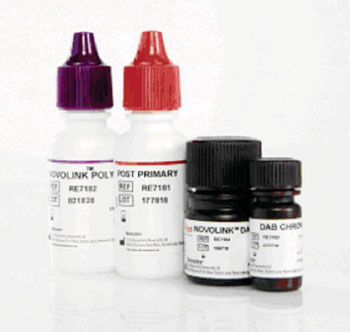
Image: The Novolink Detection kit (Photo courtesy of Leica Microsystems).
Scientists at Nottingham Trent University (Nottingham, UK) studied the biological, prognostic and predictive values of the helicase antigen (HAGE) expression in a total of 2,147 women in three well characterized cohorts of patients with breast cancer. The relationship between HAGE expression and the tumor-infiltrating lymphocytes (TILs) in matched pre-chemotherapy and post-chemotherapy samples was investigated.
The investigators used tissue microarrays (TMAs) and immunohistochemistry (IHC) to study the surgical specimens obtained from the patients. IHC staining was performed using a Novolink Detection kit (Leica Microsystems, Wetzlar, Germany). To validate the use of TMAs for immunophenotyping, full-face sections of 40 cases were stained, and the protein expression levels were compared.
The team found that 8% of the women with early primary breast cancer exhibited high HAGE expression (HAGE+) and was associated with aggressive clinicopathological features. Women with breast cancer who were considered to be at low risk, but had a high expression of HAGE, were twice as likely to die, or suffer a relapse, than those with “HAGE negative” tumors. The presence of HAGE also appears to limit the effectiveness of hormone therapy, as high risk patients with HAGE negative breast cancer lived for longer with such therapy.
The study revealed that HAGE can predict a patient's response to chemotherapy, as the incidence of relapse in patients with “HAGE positive” breast cancer following chemotherapy was lower than that in patients whose cancer did not express HAGE. Stephanie McArdle, PhD, a senior research fellow and an author of the study, said, “HAGE is implicated in the progression of breast cancer by driving cell growth, and is associated with higher grade tumors and poorer clinical outcome. This is the first report to show that this molecule is a potential prognostic marker and a predictor of a patient's response to hormone therapy and chemotherapy.” The study was published on April 22, 2014, in the British Journal of Cancer.
Related Links:
Nottingham Trent University
Leica Microsystems




Platinum Member

Automated Coagulation Analyzer
Hemolumi H6
New
Gold Member

Serum Indices Control
Acusera Serum Indices Control

CMV CLIA Diagnostic
CLIA CMV IgA Screen Group

Gold Member

Platelet Function Analyzer
PL-12