Next Generation Automated Analyzers Increase Throughput for Clinical Chemistry and Electrolyte Testing
Posted on 08 Apr 2026
Clinical laboratories continue to face staffing shortages, limited space, and growing test volumes that pressure chemistry and electrolyte workflows. Maintaining rapid turnaround times increasingly depends on high-throughput analyzers that also minimize manual maintenance. New analytical units now provide increased capacity and automation to support these needs.
Roche received U.S. Food and Drug Administration (FDA) 510(k) clearance on March 30, 2026, for the cobas c 703 and cobas ISE neo analytical units. The systems are additions to the scalable, modular cobas pro integrated solutions for mid- to very-high‑volume testing. They are designed to enhance laboratory automation to address staffing constraints, space limitations, and rising demand.
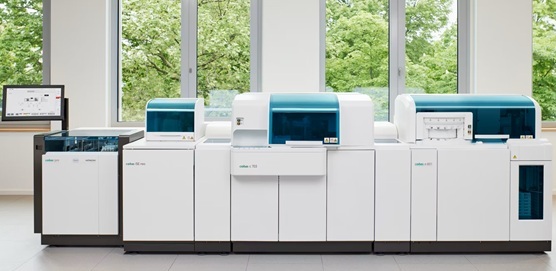
The cobas c 703 analytical unit is engineered to double clinical chemistry throughput on cobas pro integrated solutions. It delivers up to 2,000 tests per hour and provides 70 reagent positions to optimize scheduling and continuous operation. Expanded reagent capacity is intended to reduce reloads and improve workflow efficiency. Monthly operator maintenance is designed to support uptime and productivity.
The cobas ISE neo analytical unit delivers up to 1,800 tests per hour for ISE testing. Automated maintenance is intended to reduce hands-on time, helping laboratories manage higher volumes with fewer manual steps. The system provides more tests per reagent bottle compared to previous‑generation systems, minimizing plastic waste and reducing logistical efforts. Monthly maintenance supports consistent uptime. Together, the c 703 and ISE neo automate tasks traditionally performed manually, increasing test capacity and accelerating turnaround times.
Within the broader cobas pro integrated solutions platform, features include intelligent sample routing, fast STAT assay incubation times, and cobas SonicWash ultrasonic probe cleaning to help ensure sample integrity. Reagents are standardized and shared with cobas pure integrated solutions to enable flexible staffing and minimal training. Across the platform, the average sample volume required per test has been reduced by 43% compared with previous‑generation systems, and plastic generated per test result has been reduced by up to 78%.
“Laboratories are the indispensable engine of modern healthcare, and Roche wants to partner in addressing staffing-shortage challenges and an ever-increasing demand for testing,” said Brad Moore, President and CEO of Roche Diagnostics North America. “Roche is investing in solutions that help labs process more samples than ever – without sacrificing performance. The high-volume clinical chemistry and enhanced automation of the cobas c 703 and cobas ISE neo analytical units will streamline workflows, one test at a time.”





.jpg)