Multiprotein Plasma Panel Identifies Remission in Vasculitis
Posted on 27 Aug 2026
Vasculitis causes immune-mediated inflammation of blood vessel walls and can lead to kidney and lung damage. Clinicians rely on immunosuppressive drugs, but treatment carries significant side effects and identifying true remission remains difficult. Current biomarkers such as CRP often fail to distinguish active disease from remission. Researchers now describe a seven-protein plasma signature identified with proteomics and artificial intelligence that indicates remission status.
At the Max Delbrück Center for Molecular Medicine, investigators working with Charité – Universitätsmedizin Berlin developed a plasma proteomic biomarker panel to identify remission in vasculitis. The approach combines protein profiling with machine learning to select the most informative biomarkers. This process yielded a seven-protein plasma signature that, when assessed together, can indicate whether a patient is in remission.
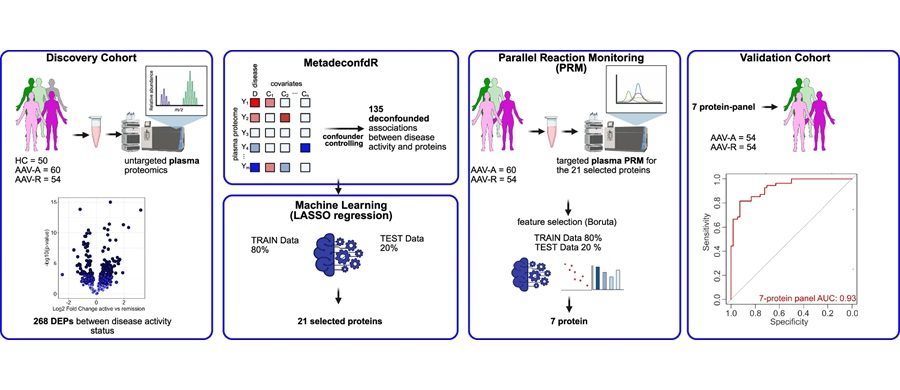
The research team profiled blood plasma from patients and healthy individuals to detect hundreds of proteins whose levels varied with disease state. Machine learning was used to prioritize proteins specific to remission while excluding confounders such as the inflammatory marker CRP. This workflow focused the analysis on remission-specific signals and avoided features that could mislead the model.
In the discovery phase, more than 100 patients with vasculitis treated at Charité were assessed, about half of whom were in remission. A control group of healthy individuals was included to contextualize protein abundance patterns. The findings were then confirmed in a separate cohort of around 100 patients from Prague with available plasma samples and clinical data.
After accounting for potential confounding factors, the combination of seven proteins reliably identified remission across cohorts. The authors note that multiprotein signatures can capture complex disease biology more comprehensively than single-analyte biomarkers. In principle, the method could also be applied to other immune and inflammatory diseases to support more precise treatment while limiting side effects.
The study, “Towards a proteomic plasma biomarker panel for diagnosing vasculitis remission,” was published in Nature Communications on July 21, 2026. The work reflects collaboration among the Max Delbrück Center for Molecular Medicine, Charité – Universitätsmedizin Berlin, the Experimental and Clinical Research Center (ECRC), and the Berlin Institute of Health at Charité (BIH).
Causal relationships between the seven proteins and vasculitis remain unclear, and a widely available diagnostic test is not yet in place. Next steps include studies with larger numbers of participants to determine performance in routine clinical practice and the extent of patient benefit.
“Advances in proteomics and AI allow us to develop these kinds of multiprotein signatures. They capture the biology of complex diseases much more comprehensively than individual protein biomarkers can,” said Dr. Philipp Mertins, head of the Proteomics Technology Platform, which is jointly operated by the Max Delbrück Center and the Berlin Institute of Health at Charité (BIH).
Related Links
Max Delbrück Center
Charité – Universitätsmedizin Berlin





 Assay.jpg)