3D Spatial Multi-Omics Maps Intra-Tumor Diversity in Colorectal Cancer
Posted on 06 Jun 2026
Colorectal cancer remains a leading cause of cancer death, and clinical decision-making is complicated by marked intra-tumor heterogeneity. Conventional bulk sequencing averages molecular signals across tumors, masking spatially distinct cell populations that contribute to progression and immune evasion. Although spatially resolved technologies can preserve this context, they are often limited by cost, scalability, or resolution. Researchers now present an AI-enabled three-dimensional spatial multi-omics strategy that reconstructs colorectal tumor architecture and immune infiltration with high spatial detail..
Researchers at Union Hospital, Tongji Medical College, Huazhong University of Science and Technology (HUST) developed Deep Visual Spatial Transcriptomics and Proteomics (DVSTP), detailed in an article published in Science Bulletin. The framework integrates high-resolution histopathology, spatial transcriptomics, and mass spectrometry–based spatial proteomics to reconstruct whole tumors in three dimensions. It identifies discrete molecular subtypes and links them to immune cell infiltration patterns.
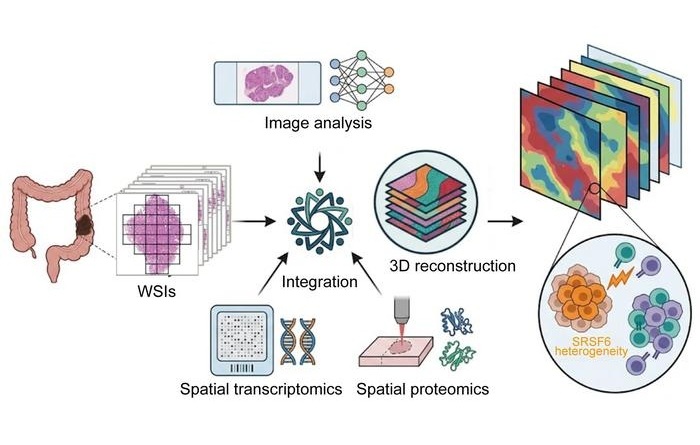
DVSTP uses deep learning to infer cellular composition from hematoxylin and eosin (H&E)–stained images and fuses these predictions with spatial transcriptomic and proteomic measurements. The team reports computational deconvolution to enhance effective resolution while maintaining accessibility by leveraging routinely generated pathology slides. The approach enables prediction of protein expression directly from H&E images and can be combined with transcriptomic data for improved performance.
Study development drew on tissue samples from 123 patients with colorectal cancer to train the imaging-based cell classifier. Investigators then analyzed serial sections from two distinct regions within a single stage II tumor, spanning 380 slices, to reconstruct the tumor’s three-dimensional organization. This design allowed assessment of how cellular neighborhoods and molecular programs vary across the tumor volume.
Across modalities, the model achieved 94% accuracy in distinguishing malignant cells, immune cells, and stromal components from H&E images. Image-based prediction of protein expression reached an area under the curve (AUC) of 0.718, rising to 0.755 when transcriptomic features were added. Because mRNA–protein concordance was only modest, with an average Spearman correlation of 0.37, the findings underscore the added value of direct spatial proteomics. This analysis identified 2,805 proteins, resolved four tumor subtypes, and was validated against The Cancer Genome Atlas dataset.
Among the heterogeneous protein signatures identified, Serine/Arginine-Rich Splicing Factor 6 (SRSF6) showed especially pronounced spatial variation and was linked to immune exclusion. SRSF6-high regions had reduced CD4+ and CD8+ T-cell infiltration, while functional experiments showed that Srsf6 overexpression promoted cancer cell migration and tumor growth and reduced T-cell presence. Conversely, knockdown produced the opposite effects, and high SRSF6 expression in patient samples correlated with poorer overall survival.
The authors note that existing spatial omics platforms remain constrained by cost and resolution. By combining standard pathology images with spatial multi-omics and whole-tumor three-dimensional reconstruction, DVSTP reveals infiltration patterns that may help identify aggressive tumor regions and anticipate therapeutic responses.
Related Links
Union Hospital, Tongji Medical College, HUST