Sequencing Methods for Hepatitis C Virus Genotyping Compared
By LabMedica International staff writers
Posted on 04 Sep 2019
Due to its high rate of mutation, hepatitis C virus (HCV) forms viral quasispecies, classified based on the highly variable regions in the envelope protein and nonstructural 5B protein (NS5B). As a result of this large genetic variability, seven genotypes and more than 67 subtypes have been identified.Posted on 04 Sep 2019
HCV genotyping is part of the evaluation of newly diagnosed patients and has always been important in guiding treatment. Considering that genotype is a key element in the management of patients infected with HCV, the determination of the genotype is recommended. The technique most frequently used to genotype HCV is quantitative real-time polymerase chain reaction (qRT-PCR). This technique is unable to provide an accurate genotype/subtype for many samples.
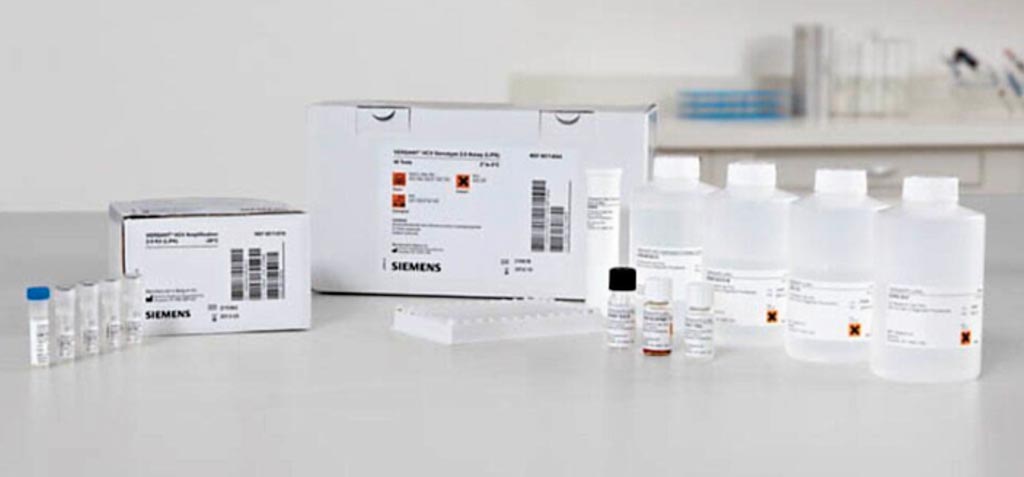
Image: The VERSANT HCV Genotype 2.0 Line Probe Assay (Photo courtesy of Siemens Healthcare Diagnostics).
Microbiologists and their colleagues working at the Université Catholique de Louvain (Brussels, Belgium) develop an in-house method with the goal of accurately identifying the genotype of all samples. The team analyzed 100 samples from HCV infected patients by the VERSANT HCV Genotype 2.0 LiPA Assay covering frequent HCV types and subtypes. NS5B, 5’UTR and Core homemade sequencing were then performed on these samples. The sequences obtained were compared with the HCV genomic BLAST bank.
The investigators reported that all the samples were characterized by the VERSANT LiPA assay (eight G1a, 17 G1b, six G2, 11 G3, 13 G4, and 10 G6). It was not possible to discriminate between G6 and G1 by the VERSANT LiPA assay for eight samples and 27 had an undetermined genotype. Forty-one samples were sequenced for the three regions: NS5B, 5’UTR and Core. Twenty-three samples were sequenced for two regions: 5′ UTR and Core and 36 samples were sequenced only for NS5B. Of the 100 samples included, 64 samples were analyzed for 5’UTR and Core sequencing and 79 samples were analyzed for NS5B sequencing. The global agreement between VERSANT LiPA assay and sequencing was greater than 95%.
The authors concluded that the high genetic variability of HCV makes it a challenge to correctly determine genotype and subtypes using commercial assays. For undetermined samples, supplementary testing is required. They described new and original methods of sequencing 5’UTR and Core regions to confirm HCV genotypes not discriminated by a commercial assay, in particular by using amplicons already obtained by the VERSANT HCV Genotype 2.0 Line Probe Assay. The study was published on August 22, 2019, in the journal BMC Infectious Diseases.
Related Links:
Université Catholique de Louvain




Platinum Member

Automated Coagulation Analyzer
Hemolumi H6
Gold Member

NEW PRODUCT : SILICONE WASHING MACHINE TRAY COVER WITH VICOLAB SILICONE NET VICOLAB®
REGISTRED 682.9
New

MR-proADM Test
B•R•A•H•M•S MR-proADM KRYPTOR test
New

Drug Testing Assays
Atellica DT 250 Analyzer