Gene Test Distinguishes Kawasaki Disease from Other Illnesses
By LabMedica International staff writers
Posted on 14 Aug 2018
Kawasaki disease (KD), the most common acquired heart disease in children, can be diagnosed using a blood test that measures a 13-transcript gene expression signature.Posted on 14 Aug 2018
Currently there are no simple diagnostic tests for Kawasaki disease. To correct this lack, investigators at the University of California San Diego (USA), Imperial College London (United Kingdom) and a group of international collaborators explored the use of whole-blood gene expression patterns to distinguish KD from other childhood infectious and inflammatory conditions.
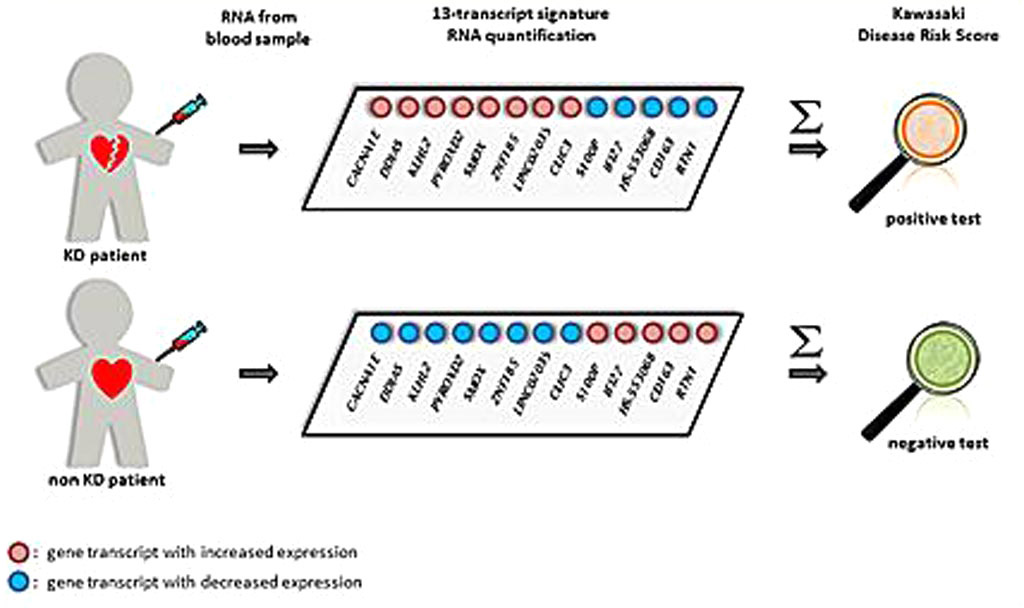
Image: A test incorporating the 13-transcripts might enable earlier diagnosis and treatment of Kawasaki Disease (Photo courtesy of the University of California, San Diego and Imperial College London).
To this end, the investigators carried out a case-control study comprising a discovery group that included training and test sets and a validation group of children with KD or comparator febrile illness. The setting was pediatric centers in the United Kingdom, Spain, the Netherlands, and the United States. The training and test discovery group comprised 404 children with infectious and inflammatory conditions (78 KD, 84 other inflammatory diseases, and 242 bacterial or viral infections) and 55 healthy controls. The independent validation group comprised 102 patients with KD, including 72 in the first seven days of illness, and 130 febrile controls. Whole-blood gene expression was evaluated using microarrays, and minimal transcript sets distinguishing KD were identified using a novel variable selection method.
Results revealed that a 13-transcript signature identified in the discovery training set distinguished KD from other infectious and inflammatory conditions in the discovery test set.
"A 13-transcript blood gene expression signature distinguished KD from the range of infectious and inflammatory conditions with which it is often clinically confused," said contributing author Dr. Jane C. Burns, director of the Kawasaki disease research center at the University of California, San Diego. "A test incorporating the 13-transcripts might enable earlier diagnosis and treatment of KD, preventing cardiac complications and reducing inappropriate treatment in those with other diseases. Our findings represent a step toward better diagnosis based on molecular signatures rather than clinical criteria."
"As there is no diagnostic test for Kawasaki disease, late diagnosis often results in delayed or missed treatment and an increased risk of coronary artery aneurysms," said Dr. Burns. "We sought to identify a whole blood gene expression signature that distinguishes children with KD in the first week of illness."
The study was published in the August 6, 2018, online edition of the journal JAMA Pediatrics.
Related Links:
University of California San Diego
Imperial College London




Platinum Member

Automated Coagulation Analyzer
Hemolumi H6
Gold Member

Neonatal Heel Incision Device
Tenderfoot

Urine Analyzer
respons® UDS100
New

Slide Scanner System
NanoZoomer S540MD