Specific Gene Expression Differentiates Moles from Melanoma
By LabMedica International staff writers
Posted on 08 Dec 2016
Most melanomas are driven by mutations that spur out-of-control cell replication, while nevi which are moles composed of non-cancerous cells at the skin surface, that harbor the same mutations do not grow wildly.Posted on 08 Dec 2016
Dermatologists surmise that 30% to 40% of melanomas, approximately 30,000 cases per year, may arise in association with a nevus. However, clinicians would like to be able to better distinguish between the two, especially in borderline cases when they examine skin tissue after a patient biopsy.
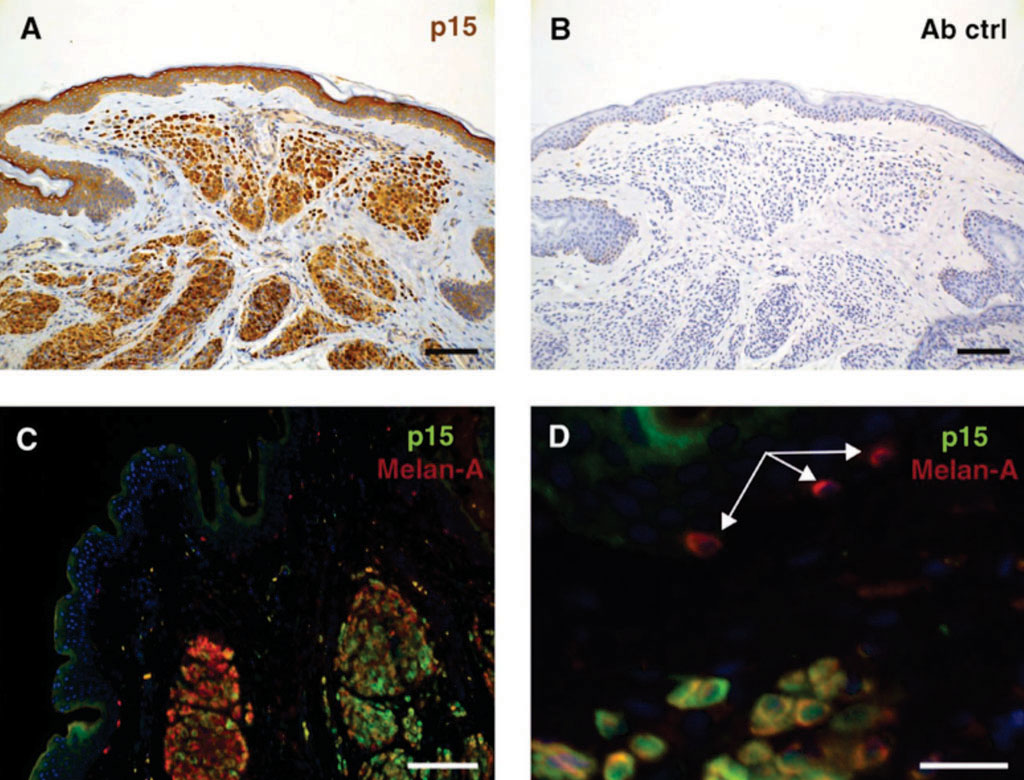
Image: p15 expressed in nevi is a key factor mediating BRAF-induced growth arrest. A, p15 expression in a benign intradermal nevus and B, antibody control C, co-immunofluorescence of p15 and Melan-A in a representative intradermal benign nevus. D, nevus melanocytes express p15, whereas non- nevus melanocytes (white arrows) are p15-negative (Photo courtesy of University of Pennsylvania).
Scientists at the University of Pennsylvania (Philadelphia, PN, USA) stained human nevus and melanoma tissue samples with p15 and p16 antibodies. Staining was evaluated and graded for percentage and intensity to determine an “H score,” which correlates with the level of protein in the cells. This approach could also form the basis of a clinical determination, taking the form of an antibody test for p15 from a patient’s biopsy specimen. Ribonucleic acid (RNA) was also extracted from 14 nevus and melanoma tissue samples to determine levels of p15 messenger RNA (mRNA). The expression of p15 mRNA was significantly increased in melanocytic nevi compared with melanomas as determined by real-time quantitative real-time quantitative polymerase chain reaction (RT-PCR) analysis.
John T. Seykora, MD, PhD, a professor of Dermatology and senior author of the study, said, “We showed that p15 expression is a robust biomarker for distinguishing nevus from melanoma. Making this distinction has been a long-standing issue for dermatologists. We hope that this new finding will help doctors determine if a nevus has transformed to melanoma. This could help doctors and patients in difficult cases. If the staining level is high then that would be most consistent with a benign nevus. If the staining level is low then that would be consistent with a melanoma.” The study was published in the December 2016 issue of the American Journal of Pathology.
Related Links:
University of Pennsylvania




Platinum Member

Automated Coagulation Analyzer
Hemolumi H6
Gold Member

Blood-Based Protein Biomarker Solution for Alzheimer's Disease
BG-DTi2000.
Platinum Member
Integrated Biochemical & Immunological System
Biolumi CX Solution X10+C10

New
Gold Member

Platelet Function Analyzer
PL-12