Tumor Markers in Blood Underpins Future Bowel Cancer Screening
By LabMedica International staff writers
Posted on 10 Dec 2014
The positivity from a two-gene DNA blood test increases with the depth of cancer invasion, tumor size, stage and presence of metastases in bowel cancer patients. Posted on 10 Dec 2014
The two-genes are known as IKAROS Family Zinc Finger 1 (IKZF1) and branched chain amino-acid transaminase 1, cytosolic (BCAT1) and they become methylated during the development of bowel cancer and the ability to detect the methylated form serves as a biomarker for this disease.
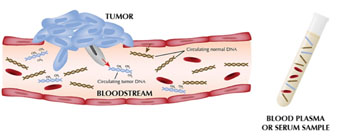
Image: Proposed mechanism of genetic material from tumor entering into circulation (Photo courtesy of University of Utah).
Scientists at Flinders Center for Innovation in Cancer (Bedford Park, SA, Australia) worked with the biotechnology company Clinical Genomics (North Ryde, NSW, Australia) who created the test. They studied a population of 1,777 people scheduled for colonoscopy— 111 were identified with bowel cancer. The blood test revealed that cancer stage, vascular invasion and metastasis significantly correlated with the presence of the two methylated DNA markers in blood.
The IKZF1 methylation patterns can change during progression of bowel cancer, thus complicating detection of early stage cancers. Using a modified blood test designed to detect a range of various methylation patterns in the IKZF1 DNA target improved the 2-gene blood test sensitivity for 24 early stage cancers (Stage I+II) from 25 to 46% leading to an overall improved sensitivity for 33 individuals for any cancer from 64% to 70%, with 92% specificity.
Susanne Pedersen, PhD, Chief Scientific Officer at Clinical Genomics, said, “Understanding the process by which DNA fragments from tumors enter into circulation in blood is crucial to building confidence around new screening approaches for the future. Pathology providers and medical practitioners are likely to be more accepting of these new screening approaches as we come to understand more about the biology and mechanisms that leads to the presence of these tumor biomarkers in blood.” The study was presented at the Australian Gastroenterology Week (AGW) conference held October 22-24, 2014, in Gold Coast (QLD, Australia).
Related Links:
Flinders Center for Innovation in Cancer
Clinical Genomics




Platinum Member

Automated Coagulation Analyzer
Hemolumi H6
Gold Member

Fully-auto Specific Protein (Nephelometry) Analyzer
PA240

New

Gastrointestinal Panel
Xpert® GI Panel

Immunofluorescence Analyzer
IFA System