Magnetically Guided Capsule Enables Targeted Small Intestine Microbiome Sampling
Posted on 05 Oct 2026
The small intestinal microbiome is difficult to study because much of the small intestine is long, narrow, and beyond the reach of routine endoscopic tools. Upper endoscopy accesses only the beginning of the small intestine, while colonoscopy primarily examines the large intestine. Capsule endoscopy can visualize the gastrointestinal tract, but commercially available capsules are generally designed for imaging rather than sample collection. Addressing this limitation, a new study shows that a magnetically controlled capsule could enable biological sampling from otherwise difficult-to-reach regions of the small intestine.
Researchers at the University of Tokyo have tested a prototype called a magnetically actuated brush-structured capsule for intestinal surface sampling. The pill-shaped device contains a flexible brush, a screw mechanism, and internal magnets. It is designed to collect samples from the surface of the small intestine while moving through the gastrointestinal tract.
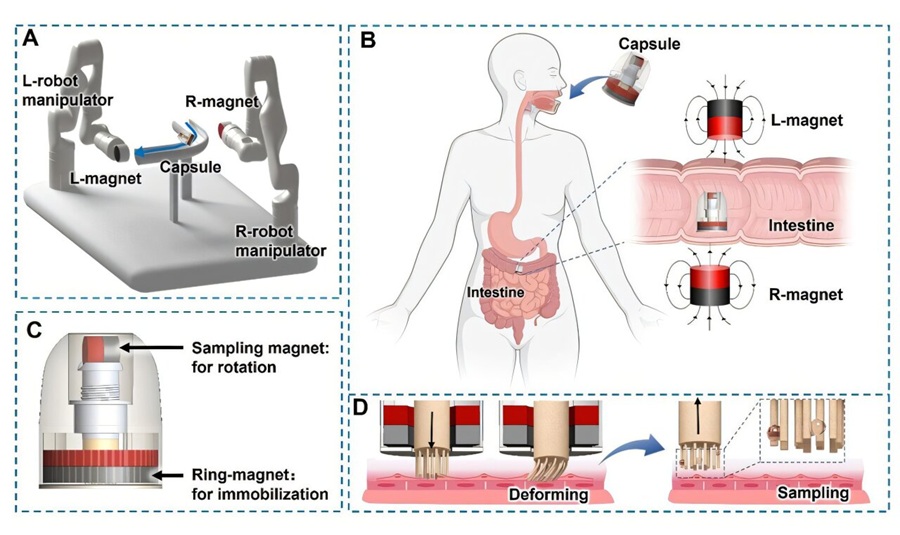
The capsule is operated using two robotic arms equipped with external magnets. One arm stabilizes the capsule near the target area without direct contact. The other arm controls the capsule’s internal screw mechanism, which extends the brush, sweeps material from the intestinal surface, and retracts the brush back into the capsule to protect the collected sample.
The team evaluated the device in laboratory tests using small intestines extracted from pigs. The capsule was magnetically controlled to move through the tissue and collect useful samples from the intestinal surface. The collected samples were suitable for 16S ribosomal RNA gene sequencing, which is commonly used for microbiome analysis.
The study was published in the journal Device on September 29, 2026. Further development is still needed before clinical testing. The researchers identified capsule miniaturization, longer magnetic operating distance, and sample protection as key challenges, because the external magnets were positioned close to the intestine during testing.
“For now, our initial results are encouraging and we are happy to be able to demonstrate that the basic concept is feasible. Our next steps are to overcome the challenges of size, operating distance and ensuring that collected samples are protected,” said Yuguo Dai, postdoctoral researcher at the Graduate School of Engineering at the University of Tokyo.
Related Links
University of Tokyo