Proteomic Workflow Maps Microbial and Host Responses in Intestinal Inflammation
Posted on 06 Aug 2026
The intestinal microbiome influences digestion, metabolism, and immunity, yet its complexity makes functional measurements difficult to obtain. DNA surveys can indicate which organisms and potential pathways are present, but they do not reveal which activities are engaged or how the host responds. Laboratories therefore need protein-level readouts that track microbial function alongside host tissue dynamics across disease. A new study shows strategies for concurrently measuring thousands of microbial and host proteins during intestinal inflammation.
At the University of Vienna, researchers systematically compared five state-of-the-art mass spectrometry approaches using human fecal samples and identified methodological strategies that provide high sensitivity, reproducibility, and functional insight. The work centers on metaproteomics, enabling simultaneous capture of microbial proteins and host proteins from the same specimens. The study also assessed whether these analytical strategies maintain performance in a biologically relevant setting.
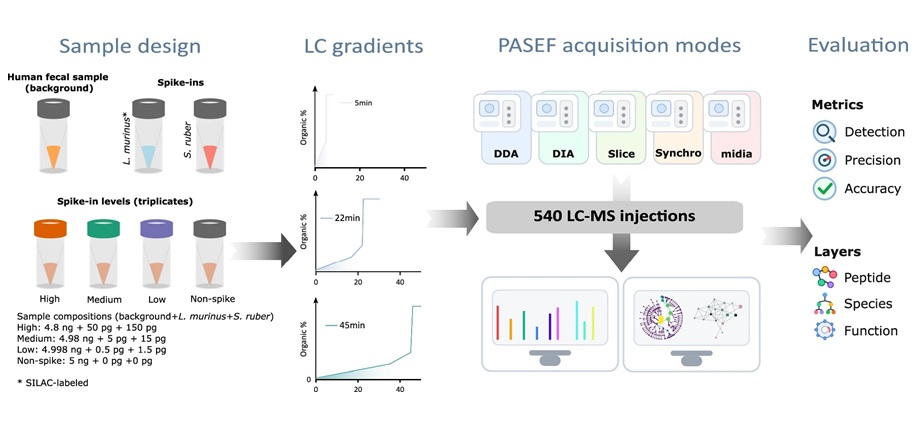
Proteins provide the missing functional information by revealing which microbial activities are currently active, how different microbiome members contribute, and how the host responds. By pairing metaproteomic profiles with organismal lists from DNA sequencing, investigators can resolve activity rather than only potential. This framework yields concurrent readouts of microbial function and host response from the same samples.
The researchers then evaluated performance in a biologically relevant setting by measuring microbial and host proteins throughout disease progression and recovery. The best-performing methods captured highly concordant host and microbial responses during the onset and recovery of intestinal inflammation, demonstrating that technological advances can translate into robust biological insights.
Collaborative contributors included the University of Vienna Bruker Daltonics Center of Excellence for Metaproteomics and the Systems Biology of Pain Laboratory (Division of Pharmacology & Toxicology) at the University of Vienna.
The findings are described in Nature Communications in an article titled “Systematic evaluation of PASEF acquisition strategies in complex metaproteomes” (2026). The study highlights methodological choices that enable large-scale, simultaneous characterization of microbial and host proteomes from human fecal specimens.
“Metaproteomics allows us to see what microbial communities are actually doing, rather than simply which microbes are present. By identifying the most suitable analytical strategies, we hope to make future microbiome research more sensitive, reproducible and accessible across medicine, environmental science and biotechnology,” said Feng Xian, first author of the study.
“Developing better technologies is essential if we want to answer the next generation of questions in microbiome research. Only by listening to the musical score played by microbes can we begin to understand why the audience—the host—responds in a particular way. This will transform our understanding of the microbiome's role in human health. We are already applying these advances in international clinical collaborations to study the involvement of microbiomes in neurological, metabolic and autoimmune diseases,” said David Gomez-Varela, director of the CoE.
Related Links
University of Vienna