Zika Virus Detected in Conjunctival Fluid
By LabMedica International staff writers
Posted on 26 Sep 2016
Researchers have found that Zika virus (ZIKV) can be detected in samples of conjunctival fluid from patients with ZIKV infection, suggesting the possibility for a simpler and safer noninvasive test for diagnosis and/or screening than blood testing. The results also add evidence about the cause of conjunctivitis in ZIKV-infected infants with microcephaly.Posted on 26 Sep 2016
Though over 80% of infections are asymptomatic, clinical symptoms are often joint pain, mild and self-limited rash, and conjunctivitis (“pink eye”). Severe eye damage in infants with microcephaly was associated with ZIKV infection; however, it has not been clear whether the eye lesions are the result of the microcephaly or directly of ZIKV infection.
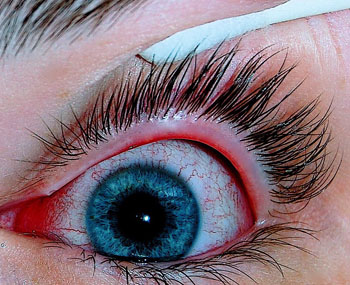
Image: An eye with viral conjunctivitis (Photo courtesy of Wikimedia).
A team led by researchers of the Guangzhou Province department of the Chinese Center for Disease Control and Prevention (China CDC; Beijing, China) examined ZIKV could be detected from conjunctival swab samples of laboratory-confirmed ZIKV cases.
Since February 2016, 11 ZIKV infection cases had been confirmed (by PCR) of Chinese travelers entering Guangdong from Venezuela. Serum and conjunctival swab samples were taken from 6 of 11 cases. The ZIKV RNA was detectable in serum no more than 5 days after symptom onset, but it was detected in conjunctival swab samples until day 7 in case 5.
“Detection of ZIKV RNA is a gold standard of confirmation of ZIKV infection. In this study, we described the direct detection and isolation of ZIKV from conjunctival swab samples. Although isolation of ZIKV in cell culture from urine, semen, saliva, and breast milk has been described, to our knowledge, detection and isolation of ZIKV from conjunctiva has not been reported so far,” the authors wrote.
“These results, though, are not sufficient to recommend the use of conjunctival swabs as alternative samples for ZIKV diagnosis because of shorter persisting and shedding time of ZIKV in conjunctiva fluid (<7 days) compared with urine and saliva samples (<20 days),” they added, “It may have implications for transmission of ZIKV, e.g. through corneal graft donors, although this report does not provide direct evidence to support that indication. Nevertheless, epidemiological data and experimental studies are needed.”
The study, by Sun J et al, was published online September 15, 2016, in the journal JAMA Ophthalmology.
Related Links:
Chinese Center for Disease Control and Prevention




Platinum Member

Automated Coagulation Analyzer
Hemolumi H6
Gold Member

Aspiration System
VACUSAFE

Immunofluorescence Analyzer
IFA System


Automated Clinical Chemistry Analyzer
Envoy 500+