Urinary Tract Infection Tracked by Routine and Automated Urinalysis
By LabMedica International staff writers
Posted on 13 Sep 2016
Urinary tract infections (UTIs) are frequently encountered and the diagnosis of UTI using urine dipstick, Gram stain, urine culture often lack proven accuracy and precision in the emergency department (ED).Posted on 13 Sep 2016
Because of its swiftness and low cost, urine dipstick (UD) is a commonly used test at the ED, but diagnostic accuracy is, however, based on primary care settings and therefore not compatible with the ED. UTI is confirmed by results of urine cultures (UCs), which are labor intensive, time consuming, and not available within the time frame of an ED visit.
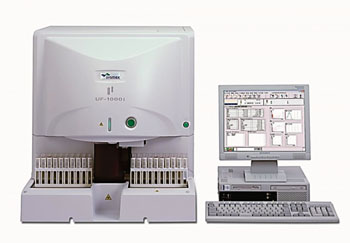
Image: The UF-1000i fully automated urine particle analyzer (Photo courtesy of Sysmex Corporation).
Scientists at the University Medical Center Groningen (The Netherlands) analyzed a total of 381 cases presenting with fever and/or clinically suspected UTI. The following specific symptoms for UTI were determined: dysuria, pollakisuria, urinary urgency, hematuria, and back pain/lower abdominal pain. In addition, specific symptoms of UTI were determined: fever, chills, malaise, flank or perineal pain, and delirium.
For Gram staining, 10 μL of uncentrifuged urine was used. The color (gram negative or gram positive); shape (rods or cocci); and number of leukocytes, erythrocytes, and bacteria per high-power field (hpf) were determined semi-quantitatively at 100 × 10 magnification. The automated stick reader cobas u 411 was used with the UD Combur10 test (Roche Diagnostics, Mannheim, Germany). For UC, 1 μL of urine was inoculated on two agars (sheep blood agar and MacConkey3 agar) and incubated at 35°C for 16-20 hours in ambient air. Isolated organisms were measured semi-quantitatively as number of colony-forming units (CFU) per milliliter. For automated urine particle analysis, the team used the Sysmex UF-1000i (Sysmex Corporation, Kobe, Japan) is a fully automated urine particle analyzer based on flow cytometry.
The scientists reported 143 (37.5%) cases were diagnosed with UTI. Sensitivity of urine dipstick nitrite was 32.9% and specificity was 93.7%. Sensitivity of urine dipstick leukocyte esterase (3+) was 80.4% and specificity was 82.8%. Of the 143 cases with a UTI, 91 had a noninvasive UTI, 16 had a urosepsis confirmed by blood culture, 24 had a urosepsis based on clinical presentation, 11 had a pyelonephritis, and one had a prostatitis. Receiver operating characteristic curves of automated bacterial and leukocyte count showed area under the curve of 0.851 and 0.872, respectively. Cutoff values of 133 bacteria/μL and 48 leukocytes/μL resulted in a greater than 90% sensitivity.
The authors concluded that that in an unselected patient group presenting to the ED with suspected UTI, automated urine particle analysis with counts of leukocytes and bacteria results in comparable diagnostic accuracy compared with standard dipstick analysis but can slightly improve diagnostic accuracy, especially to make UTI unlikely, when added to standard clinical and UD analysis. The study was published in the August 2016 issue of the American Journal of Emergency Medicine.
Related Links:
University Medical Center Groningen
Roche Diagnostics
Sysmex Corporation




Platinum Member

Automated Coagulation Analyzer
Hemolumi H6
Gold Member

Nucleic Acid Extractor System
NEOS-96 XT

Automated Urinalysis Solution
UN-9000
New

Portable POCT Blood Gas Analyzer
BD100