Major Advancement Detects Cystic Fibrosis Lung Infections
By LabMedica International staff writers
Posted on 10 Aug 2015
A novel diagnostic approach has been developed that offers an unprecedented rapid and accurate diagnosis of lung infections in patients with cystic fibrosis, a disease affecting around 9,000 people in the UK. Posted on 10 Aug 2015
Respiratory infection in cystic fibrosis (CF) is polymicrobial, but standard sputum microbiology does not account for the lung microbiome or detect changes in microbial diversity associated with disease.
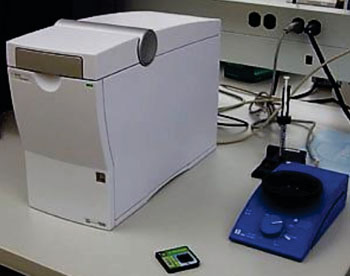
Image: The Agilent 2100 Bioanalyzer microfluids-based platform (Photo courtesy of the University of Oklahoma).
Scientists at the University Hospital of South Manchester (UK) and their colleagues collected 200 sputum specimens from 93 CF patients. In all cases, CF had been diagnosed prior to study entry on the basis of clinical, biochemical, and genetic results in line with standard clinical practice. At each visit, patients provided paired sputum samples for conventional culture and culture-independent analysis and ribosomal intergenic spacer analysis (RISA) and 16S ribosomal ribonucleic acid (rRNA) gene pyrosequencing.
RISA polymerase chain reaction (PCR) was performed and the 2 μL of amplified DNA amplicons were separated by the 2100 Bioanalyzer microfluidics (Agilent Technologies; Santa Clara, CA, USA), and their profiles were analyzed using Gelcompar II (Applied Maths; Sint-Martens Latem, Belgium). A subset of samples from 60 patients representative of the diversity observed by RISA profile cluster analysis were selected for 16S rRNA gene pyrosequencing analysis performed by Research and Testing Laboratory Inc. (Lubbock, TX, USA).
Compared to the microbiology data, RISA profiles clustered into two groups: the emerging non-fermenting Gram-negative organisms (eNFGN) and Pseudomonas groups. Patients who were culture positive for Burkholderia, Achromobacter, Stenotrophomonas, and Ralstonia clustered within the eNFGN group. Pseudomonas group RISA profiles were associated with Pseudomonas aeruginosa culture-positive patients.
The authors concluded that nucleic acids isolated from CF sputum can serve as a single template for both molecular virology and bacteriology, with a RISA PCR rapidly detecting the presence of dominant eNFGN pathogens or P. aeruginosa missed by culture as was observed in 11% of cases. They showed how this straightforward CF microbiota profiling scheme may be adopted by clinical laboratories.
Eshwar Mahenthiralingam, PhD, a senior author of the study, said, “By taking advantage of existing virology sample processing methods, and applying simple bacterial genetic tests, we can accurately diagnose infections with very problematic antibiotic-resistant bacteria. Better diagnosis of these infections will improve treatment, quality of life and survival for people with cystic fibrosis.” The study was published in the July 2015 issue of the Journal of Clinical Microbiology.
Related Links:
University Hospital of South Manchester
Agilent Technologies
Applied Maths




Platinum Member

Automated Coagulation Analyzer
Hemolumi H6

New

Drug Testing Assays
Atellica DT 250 Analyzer
Gold Member

NEW PRODUCT : SILICONE WASHING MACHINE TRAY COVER WITH VICOLAB SILICONE NET VICOLAB®
REGISTRED 682.9