Nasal Test Developed to Diagnose Creutzfeldt-Jakob Disease
By LabMedica International staff writers
Posted on 20 Aug 2014
A nasal brush test has been developed that can rapidly and accurately diagnose Creutzfeldt-Jakob disease (CJD), an incurable and ultimately fatal neurodegenerative disorder.Posted on 20 Aug 2014
Definite diagnosis of sporadic CJD in living patients remains a challenge as up to now, a definitive CJD diagnosis requires testing brain tissue obtained after death or by biopsy in living patients.
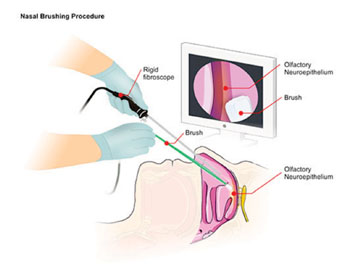
Image: The nasal brushing test involves the insertion of a rigid fiber-optic rhinoscope into the patient’s nasal cavity. A sterile brush is then inserted alongside the scope to collect olfactory neurons by gently rolling along the mucosal surface (Photo courtesy of Dr. Gianluigi Zanusso, MD, PhD).
An international team of scientists led by those at the National Institute of Allergy and Infectious Diseases (Bethesda, MD, USA) studied 31 nasal samples from patients with CJD and 43 nasal samples from patients who had other neurologic diseases or no neurologic disease at all. They obtained olfactory mucosa samples by using a nasal tampon, a rigid fiberoptic rhinoscope, enveloped with a disposable sheath, the Slide-On EndoSheath System (Medtronic Xomed; Minneapolis, MN, USA) and a sterile, disposable brush was then inserted alongside the fibroscope, gently rolled on the mucosal surface and withdrawn, and processed.
An in vitro PrPCJD amplification technology, designated real-time quaking-induced conversion (RT-QuIC), has been shown to have considerable promise as a highly specific diagnostic test for sporadic Creutzfeldt–Jakob disease. Testing with RT-QuIC correctly identified 30 of the 31 CJD patients (97% sensitivity) and correctly showed negative results for all 43 of the non-CJD patients (100% specificity). By comparison, tests using cerebral spinal fluid which is currently used to detect sporadic CJD were 77% sensitive and 100% specific, and the results took twice as long to obtain.
Anthony S. Fauci, MD, director of the National Institute of Allergy and Infectious Diseases, said, “This exciting advance, the culmination of decades of studies on prion diseases, markedly improves on available diagnostic tests for CJD that are less reliable, more difficult for patients to tolerate, and require more time to obtain results. With additional validation, this test has potential for use in clinical and agricultural settings.” The study was published on August 7, 2014, in the New England Journal of Medicine (NEJM).
Related Links:
US National Institute of Allergy and Infectious Diseases
Medtronic Xomed




Platinum Member

Automated Coagulation Analyzer
Hemolumi H6
.jpg)
Gold Member

Clinical Chemistry Assay
Sorbitol Dehydrogenase (SDH)
Gold Member

Platelet Function Analyzer
PL-12
New
Alzheimer's Disease Biomarker Assay
Elecsys Phospho-Tau (217P) Plasma