Deadly Drug-Resistant Strain of Escherichia coli Emerged as a Single Genetic Clone
By LabMedica International staff writers
Posted on 02 Jan 2014
Molecular microbiologists working with advanced genomic research tools have shown that an extremely virulent and drug-resistant strain of Escherichia coli appeared about 10 years ago following mutations in two genes.Posted on 02 Jan 2014
Previous studies on the H30-Rx clone of the ST131 strain of E. coli using pulsed-field gel electrophoresis (PFGE) had indicated that characteristics such as propensity for extraintestinal infections, fluoroquinolone resistance, and extended-spectrum beta-lactamase (ESBL) production had arisen as a series of independent genetic events. If this conclusion were correct, it would suggest that the existence of many different intermediate strains would exist with multiple pathways for evading the immune system and medical treatment.
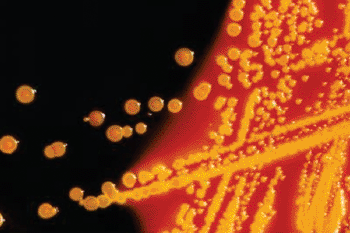
Image: Colonies of Escherichia coli growing in a laboratory culture (Photo courtesy of the CDC - Centers for Disease Control and Prevention).
However, in a new study published in the December 17, 2013, edition of the journal mBio, investigators at George Washington University School of Public Health (Washington DC, USA) and their colleagues at the University of Minnesota (Minneapolis, USA) used the advanced genomic technique, whole-genome sequencing, to reconstruct the evolutionary history of the ST131 clone. The investigators analyzed the genomes of samples of E. coli collected from patients and animals in five countries over the 44-year period, 1967–2011.
They found that fluoroquinolone resistance was confined almost entirely to a single, rapidly expanding ST131 subclone, designated H30-R. This clone, which was fully resistant to the drug ciprofloxacin, soon morphed into a new clone called H30-Rx, which was resistant to several extended-spectrum antibiotics, such as third-generation cephalosporins.
The investigators believe that the clonal nature of H30-Rx may provide opportunities for vaccine or transmission prevention-based control strategies, which could gain importance as H30-Rx and other extraintestinal pathogenic E. coli subclones become resistant to an increasing number of antibiotics.
"This strain of E. coli spreads from person to person and seems to be particularly virulent," said contributing author Dr. James R. Johnson, professor of medicine at the University of Minnesota. "This study might help us develop better tools to identify, stop or prevent its spread by finding better ways to block the transmission of the superbug, or by finding a diagnostic test that would help doctors identify such an infection early on, before it might have the chance to turn lethal."
Related Links:
George Washington University School of Public Health
University of Minnesota




Platinum Member

Automated Coagulation Analyzer
Hemolumi H6
Gold Member

Neonatal Heel Incision Device
Tenderfoot

Hematology Consumables
Bioblood Devices

Automated Urinalysis Solution
UN-9000