Rapid Diagnostic Tests Compared for Invasive Amoebiasis
By LabMedica International staff writers
Posted on 30 Oct 2013
Three rapid immunoassays have been compared and evaluated for the diagnosis of invasive amoebiasis in an emergency department. Posted on 30 Oct 2013
Sensitive rapid diagnostic tests (RDT) contribute to an early diagnosis and thus improve the prognosis. The test should be also specific to distinguish amoebic and pyogenic abscess in order to avoid a percutaneous drainage for diagnostic purposes and a broad-spectrum antibiotherapy.
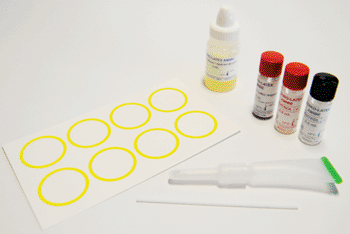
Image: Bichrolatex-Amibe colored latex slide agglutination test for extra-intestinal amoebiasis serodiagnosis (Photo courtesy of Fumouze Diagnostic).
Scientists at the Military Teaching Hospital (HIA) Bégin (Saint-Mandé, France) carried out a retrospective biological records review that included 639 patients for whom three serological tests were performed. They compared a latex agglutination test (LAT) with enzyme-linked immunosorbent assay and indirect hemagglutination assay in the diagnosis of invasive amoebiasis (IA) performed from January 1, 2001, to July 1, 2012.
The three different techniques performed for each patient at laboratory of Bégin Hospital were: a latex agglutination slide test (LAT) (Bichrolatex-Amibe, Fumouze Diagnostic; Levallois-Perret, France); an enzyme linked immunosorbent assay (ELISA) (NovaTec Entamoeba histolytica IgG-ELISA, DiaSorin SPA; Saluggia, Italy); and the Fumouze Diagnostic’s indirect hemagglutination assay Amibiase HAI (IHA).
A total of 639 patients with a performed serology were included and among them 75 had at least one positive serological result. Of these 75 patients, 46 had a final diagnosis of IA, 43 with hepatic amoebiasis, two with intestinal amoebomas and one with pleuropulmonary amoebiasis and 29 patients had another final diagnosis. The LAT was statistically more sensitive than ELISA and IHA.
The authors concluded that LAT could be used in any routine clinical laboratory because it is simple to perform and does not require any special equipment. The result is achieved quickly in 15 minutes. The interpretation is easy because the bicolored positive pattern is very distinguishable from a negative brown spot. The cost remains low at approximately EUR 5.22 per test in France. The LAT is a useful screening technique in the rapid diagnosis and the management of patients with febrile hepatalgia in emergency units. However, this test should be systematically confirmed by reference techniques (ELISA, IHA). The study was published on October 11, 2013, in the journal Diagnostic Microbiology and Infectious Disease.
Related Links:
Military Teaching Hospital Bégin
Fumouze Diagnostic
DiaSorin SPA




Platinum Member

Automated Coagulation Analyzer
Hemolumi H6
Gold Member

Nucleic Acid Extractor System
NEOS-96 XT
New
Gold Member

Serum Indices Control
Acusera Serum Indices Control

Hematology Consumables
Bioblood Devices