Rapid Diagnostic Tests Used as Source for Malaria DNA
By LabMedica International staff writers
Posted on 04 Apr 2011
Malaria rapid diagnostic tests (RDTs) can be used as a resource for extracting malaria DNA for use with molecular confirmative technology.Posted on 04 Apr 2011
RDTs are frequently used as an adjunct to microscopy in the diagnosis of malaria and in settings where high quality microscopy is not available; the detection of Plasmodium infections is often based on RDTs alone.
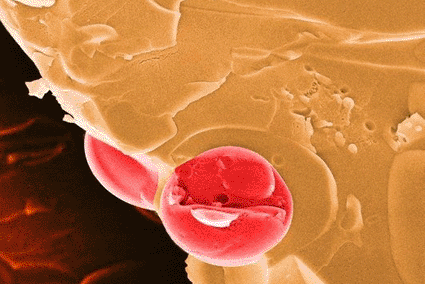
Image: Colored scanning electron micrograph (SEM) of a freeze fractured malarial red blood cell (erythrocyte, brown) infected with a Plasmodium falciparum protozoan (red) (photo courtesy of the NIBSC).
At present, there is no widely accepted way of assessing the quality of RDTs at the end-user level and both microscopy and real time polymerase chain reactions (RT-PCR) could be used as reference methods. Scientists at the Institute of Tropical Medicine (Antwerp, Belgium) investigated the best method of extracting DNA from RDTs that would be used in a RT-PCR method. DNA extraction method was assessed on 12 different RDT brands and two RDT brands were comprehensively evaluated on a panel of clinical samples submitted for routine malaria diagnosis.
The DNA amplification was done with the 18S ribosomal ribonucleic acid (rRNA) real-time PCR targeting the four malaria species. The results of the PCR from RDT samples were compared to those obtained by PCR on whole blood samples. The PCR on RDT DNA showed a detection limit of 0.02 asexual parasites/µL, which was identical to the same PCR on whole blood. PCR analysis on clinical RDT samples demonstrated correct identification for single species infections for all RDT samples with asexual parasites of 60 Plasmodium falciparum samples and 10 samples each of P. vivax, P. ovale, and P. malariae. Samples with only gametocytes were detected in all OptiMAL Rapid Malaria Test (Diamed AG, Cressier, Switzerland), and in 10 of the 11 SDFK60 malaria Antigen Plasmodium falciparum/Pan tests (Standard Diagnostics Inc, Suwon, Korea).
The authors concluded that in reference settings, PCR on RDT could be applied for confirmation of malaria infection when the whole blood sample is not available. Real-time PCR is of added value as it can distinguish between non-falciparum species and differentiate between single and mixed infections. Another application is post-travel quality control by PCR on for travelers returning home that used a RDT marketed for self-use during their travel. The study was published on March 24, 2011 in the Malaria Journal.
Related Links:
Institute of Tropical Medicine
Diamed AG
Standard Diagnostics Inc.




Platinum Member

Automated Coagulation Analyzer
Hemolumi H6
New
Gold Member

Serum Indices Control
Acusera Serum Indices Control

Automated Urinalysis Solution
UN-9000

Manual Pipetting Aid
Pipette Controllers macro