Multimodal Clinical Data Models Predict Cachexia Risk Across Cancers
Posted on 16 Oct 2026
Cancer cachexia is a severe wasting syndrome that affects roughly half of patients with cancer and cannot be reversed simply by increasing food intake. It can reduce treatment tolerance, impair quality of life, and is associated with poorer outcomes, yet its biological drivers remain incompletely understood over time in human patients. New findings now show that routine clinical and laboratory data can reveal recurring patterns associated with cachexia across different cancer types.
Memorial Sloan Kettering Cancer Center (MSK; New York, NY, USA) and collaborators developed a health-system-scale, episode-resolved multimodal atlas of cancer cachexia using clinical data collected during cancer care. The analysis searched patient weight histories for any six-month period meeting the clinical definition of cachexia, which is at least 5% body weight loss. The approach combined longitudinal body mass index trajectories, routine serologic laboratory tests, radiology-derived disease progression annotations, treatment histories and tumor genomic profiling.
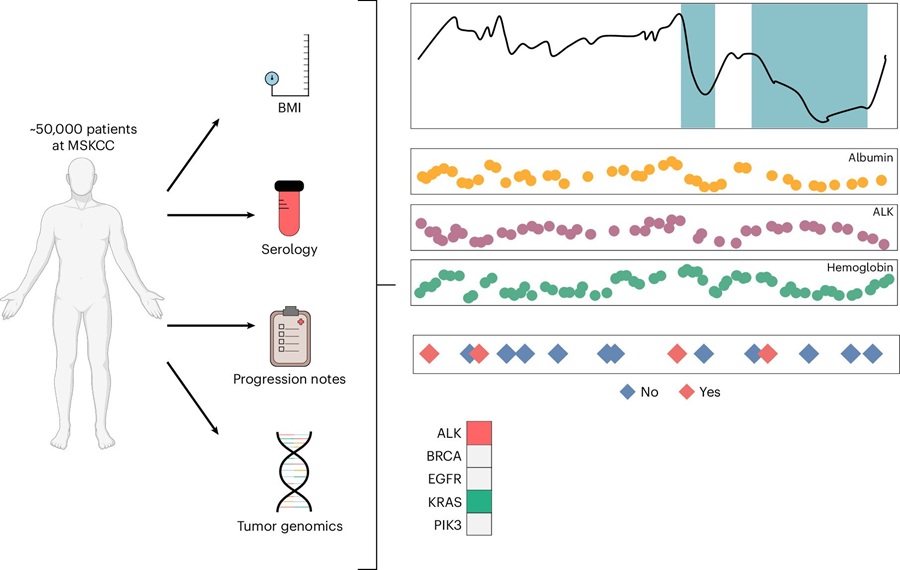
The study analyzed data from nearly 60,000 patients with cancer, including more than 2 million body weight measurements and millions of blood test results. The MSK-IMPACT cohort alone included 52,236 patients. Spanning more than 650 cancer types, the analysis was described as the largest human study of cancer cachexia to date.
The findings showed that cachexia occurs across nearly all forms of cancer and often develops in distinct episodes that can recur over the course of illness. These episodes were somewhat more common when tumors were progressing or treatment was beginning to fail, although many occurred independently of disease progression. In colorectal cancer, nearly one-third of progression events coincided with cachexia, with similar patterns observed in lung and pancreatic cancers.
Routine blood testing also revealed a consistent cachexia-associated signature across nearly all cancer types studied. Wasting episodes were linked to lower albumin, hemoglobin, and red blood cell counts, as well as elevated liver enzymes and higher white blood cell and neutrophil counts.
The study further associated specific tumor mutations with cachexia risk, including TP53 across nine cancer types, STK11 in lung cancer, and SMAD4 and KRAS in colorectal cancer, while ARID1A and KMT2B appeared to be associated with lower risk in colorectal cancer.
The team developed predictive models for lung adenocarcinoma and colorectal carcinoma using tumor genetics, disease stage, ability to maintain daily activities and baseline body weight. The models generated individualized risk scores for cachexia over one, two and three years and were described as moderately accurate. The findings were published in Nature Medicine on October 12, 2026.
“Much of this was routine clinical information being collected to help understand how a patient is doing at different points in time over the course of their treatment. It turns out the data had a lot to tell us,” said Ed Reznik, Ph.D., study senior author at Memorial Sloan Kettering Cancer Center.
“Cachexia affects the whole body, so it makes sense that we see a variety of markers in patients' blood. Across almost all cancer types, we saw this same signature associated with cachexic weight loss,” Reznik added.
Related Links
Memorial Sloan Kettering Cancer Center