Multi-Omics Study Identifies Blood Marker for MASLD Progression
Posted on 12 Oct 2026
Metabolic dysfunction-associated steatotic liver disease (MASLD) is a major cause of liver-related morbidity and mortality worldwide. As MASLD progresses, fibrosis and liver-related events, including hepatocellular carcinoma and other complications, become important indicators of clinical risk. Liver biopsy is invasive and costly, while current noninvasive biomarkers and imaging approaches have limitations. Now, a new study shows that serum complement C7 may help assess fibrosis and predict liver-related events in MASLD.
Shinshu University (Matsumoto, Japan) researchers investigated serum complement C7 as a potential biomarker of fibrosis and disease progression in MASLD. The team used an integrative multi-omics approach incorporating transcriptomics, proteomics, spatial and single-cell analyses, and in vitro functional validation. The study evaluated C7 across independent cohorts, including 430 patients with biopsy-confirmed MASLD, 120 patients assessed with vibration-controlled transient elastography (VCTE), and 4,486 UK Biobank participants.
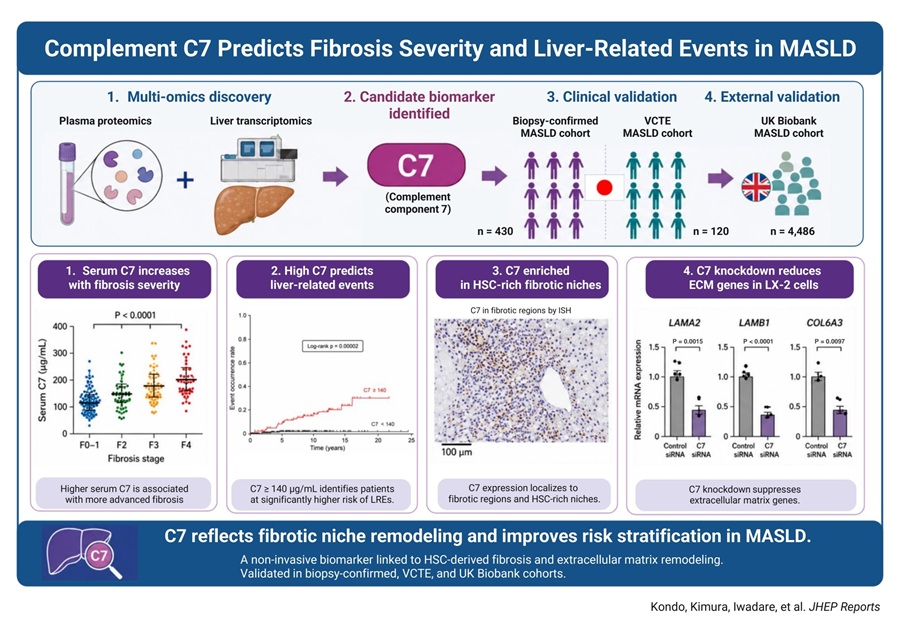
Serum C7 levels were associated with fibrosis stage and liver stiffness. A serum C7 threshold of 140 μg/mL was associated with higher incidence of liver-related events. After adjustment for other factors, elevated C7 remained independently associated with liver-related events, with a hazard ratio of 4.54 and a 95% confidence interval of 1.49–13.82.
C7 achieved an area under the receiver operating characteristic curve of 0.90 for detecting liver-related events in the VCTE cohort. This compared with 0.85 for the fibrosis-4 index, 0.84 for autotaxin, 0.77 for the aspartate aminotransferase to platelet ratio index, 0.75 for FibroScan-AST, and 0.67 for the aspartate aminotransferase-to-alanine aminotransferase ratio. The findings were further supported by external validation in the UK Biobank cohort.
The multi-omics analyses localized C7 expression to activated hepatic stellate cells within fibrotic liver regions. Single-nucleus RNA sequencing identified hepatic stellate cells as an important source of C7, and C7 expression was associated with extracellular matrix organization and fibrogenic pathways. In cultured LX-2 hepatic stellate cells, small interfering RNA-mediated C7 knockdown reduced expression of extracellular matrix-related genes, including LAMA2, LAMB1, and COL6A3. The paper was published in JHEP Reports.
The findings suggest that measuring serum C7 could provide information about fibrosis burden and clinically relevant disease progression. The study does not establish that C7 directly causes liver fibrosis or liver-related events. Differences between study cohorts may affect generalizability, and in vivo experiments and prospective studies are needed to establish causality and determine clinical utility for long-term risk stratification and monitoring.
“This study identified complement C7 as a novel biomarker associated with fibrosis progression and LREs in MASLD using a comprehensive multi-omics approach. Serum C7 holds promise as a noninvasive biomarker for stratifying fibrosis severity and predicting clinical outcomes in MASLD,” said Dr. Takefumi Kimura from Shinshu University.
Related Links
Shinshu University