AI Histopathology Tool Distinguishes Ewing Sarcoma for Diagnosis
Posted on 09 Oct 2026
Ewing sarcoma is a rare malignant tumor that mainly affects children, adolescents, and young adults. It usually arises in bone but can also develop in soft tissue, where its microscopic appearance may resemble other tumor types. This similarity can complicate diagnosis, particularly when biopsy material is limited. To support more consistent differentiation in challenging cases, new findings demonstrate an AI system designed to distinguish Ewing sarcoma from morphologically similar tumors.
Universitat Politècnica de València and the University of Valencia developed and validated the AI system for digital pathology. The tool analyzes digitized histological samples and identifies microscopic patterns associated with each tumor type. It then generates a classification intended to support anatomical pathology decision-making, particularly when only small biopsy samples are available.
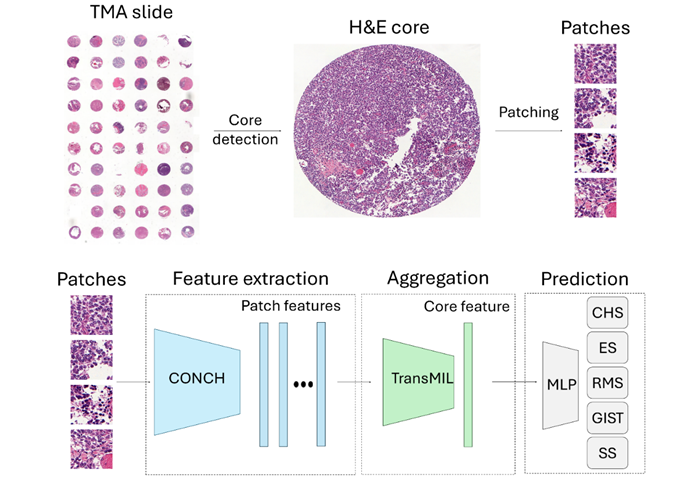
The system was developed by the CVBLab research group at Universitat Politècnica de València and Artikode Intelligence, a UPV spinoff. It was trained and evaluated using 1,926 digitized histological samples from 729 patients at four hospitals in Spain and Italy. The cohort included 517 cases of Ewing sarcoma, along with rhabdomyosarcoma, chondrosarcoma, gastrointestinal stromal tumors, and synovial sarcoma.
The model achieved overall diagnostic accuracy of 91.6%. For Ewing sarcoma specifically, sensitivity reached 97.1%. The system also showed a marginal error rate of 1.96% between Ewing sarcoma and rhabdomyosarcoma, described as the most challenging differential diagnosis among small round cell tumors.
The study was published in the International Journal of Molecular Sciences. Collaborating institutions included Universitat Politècnica de València, the University of Valencia, INCLIVA Institute for Health Research, Artikode Intelligence, and four hospitals in Spain and Italy. The findings position the approach as objective diagnostic support for pathologists and as a way to help preserve scarce biopsy tissue by guiding confirmatory testing.
“The novelty of the project does not lie simply in using AI to diagnose Ewing sarcoma, as experimental deep learning approaches already exist in this field. Our distinctive contribution lies in the combination of the clinical problem addressed, the type of data, the classification strategy and the focus on developing a tool applicable to real-world digital pathology,” stated Francisco Giner, lead researcher and first author of the article.
Related Links
Universitat Politècnica de València
University of Valencia