Bile DNA Testing Detects Tumor Signals Before Conventional Cancer Diagnosis
Posted on 02 Oct 2026
Distinguishing malignant from benign biliary strictures can be difficult when tissue samples are limited or disease is early. Endoscopic retrograde cholangiopancreatography (ERCP)-guided cytology and biopsy may be inconclusive, while serum carbohydrate antigen 19-9 can also rise with cholestasis and inflammation. These limitations can delay diagnosis. To provide more informative sampling, new findings show that bile collected during routine ERCP can reveal tumor-derived genomic information.
The study evaluated ultra-low-pass whole-genome sequencing (ULP-WGS) of bile cell-free DNA as a method for detecting malignancy, classifying tumor origin, and supporting prognostic stratification. The approach used 2 ng of bile cell-free DNA sequenced at approximately 0.2× genomic coverage. Large-scale copy-number alterations were identified using the open-source ichorCNA pipeline, which also estimated tumor fraction. A tumor fraction of at least 10% was considered evidence of detectable circulating tumor DNA.
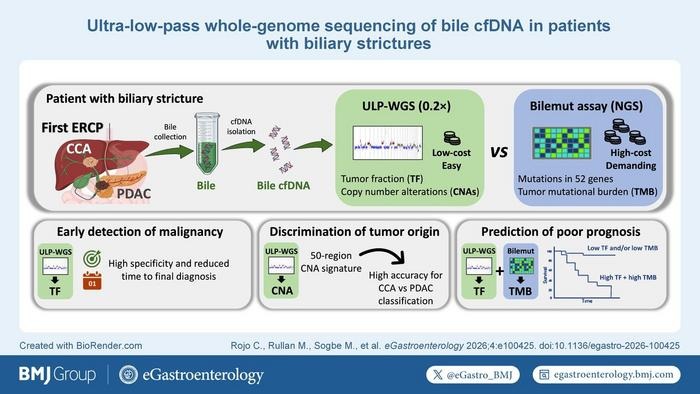
Investigators prospectively analyzed 95 patients undergoing their first ERCP for a radiologically suspicious biliary stricture. Initial pathology classified 26 strictures as malignant and 69 as indeterminate. After up to 12 months of follow-up, 45 of the initially indeterminate cases were confirmed as malignant and 24 as benign. The final malignant cohort included 40 cholangiocarcinomas (CCAs) and 31 pancreatic ductal adenocarcinomas (PDACs).
Among patients with an initial pathological diagnosis of malignancy, bile ULP-WGS detected tumor DNA in 73% of cases. Detection reached 82% in cholangiocarcinoma and 56% in pancreatic ductal adenocarcinoma. Among initially indeterminate strictures later confirmed as malignant, sensitivity was 51%, while 23 of 24 ultimately benign cases tested negative, resulting in a specificity of 96%. By comparison, carbohydrate antigen 19-9 at a threshold of 44 U/mL showed 53% specificity among evaluable benign cases.
In 23 positive cases without malignancy established at first endoscopic retrograde cholangiopancreatography, tumor DNA was detected a median of 38 days before conventional diagnosis. A 50-region copy-number alteration classifier distinguished cholangiocarcinoma from pancreatic ductal adenocarcinoma with 86.4% accuracy in the reference cohort and 85.0% in a validation cohort. The study was published in eGastroenterology in 2026. The authors noted that the method is not sensitive enough to exclude malignancy when negative, but may complement histopathology after inconclusive initial sampling.