Magnetic Nanoparticles Enable More Sensitive Beta-Lactam Allergy Testing
Posted on 16 Sep 2026
Penicillin allergy labels are common in clinical practice, yet many are incorrect and can lead to suboptimal antibiotic choices. Although 8%–25% of people report a penicillin allergy, only 1%–10% are truly allergic, underscoring the need for accurate in vitro tools that reduce unnecessary avoidance of first-line beta-lactams. To support more reliable diagnosis, researchers have developed a nanoparticle-based method to detect allergy to amoxicillin and other penicillins.
The University of Malaga (Malaga, Spain) has developed an in vitro diagnostic platform that uses 30-nanometer magnetic nanoparticles to detect allergy to beta-lactam antibiotics. Each particle has an iron oxide core and a silica shell that functions “like a tiny magnet covered with thousands of molecular hooks,” enabling high-efficiency capture of IgE antibodies associated with allergic responses. The approach is designed for precise, rapid, and reliable analysis using patient blood.
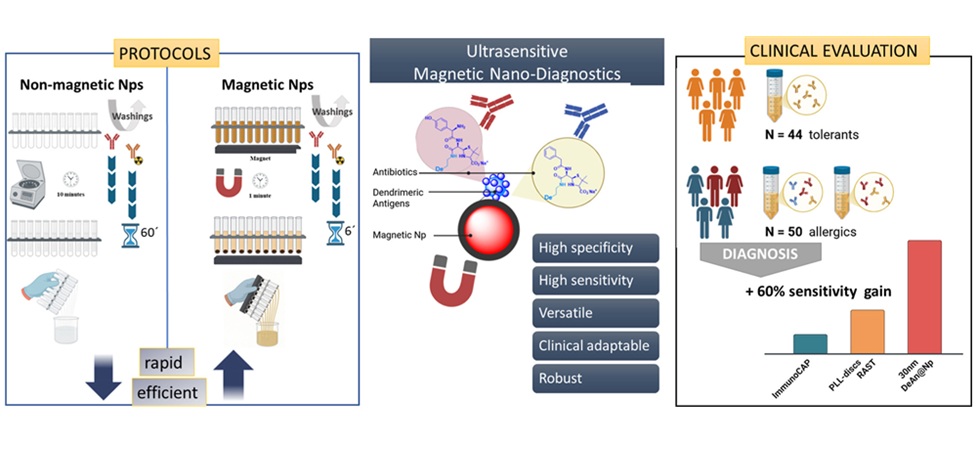
By concentrating allergen-specific IgE on the nanoparticle surface, the platform increases binding events compared with conventional assays, enhancing analytical sensitivity. The method can be performed in the laboratory without drug provocation tests, thereby avoiding procedures that carry clinical risk for patients. It also simplifies sample handling by eliminating lengthy centrifugation steps described in standard workflows.
The study analyzed blood from nearly 100 individuals, including 50 patients with confirmed amoxicillin allergy and 44 who tolerated penicillins. Results were benchmarked against ImmunoCAP, the most widely used commercial test, and conventional RAST. For amoxicillin, the nanoparticle platform achieved 98% sensitivity, whereas ImmunoCAP detected only around 17%.
The findings were published in Materials Today Bio and involved researchers from the IBIMA BIONAD Platform, the Inflammatory Diseases Network (REI), and the Regional University Hospital of Malaga. The investigators note that penicillin allergy is frequently overdiagnosed, leading to the use of alternatives that are often less effective, more toxic, and that contribute to bacterial resistance. They emphasize the need for larger multicenter studies and clinical validation before routine hospital use.
“In the tests performed, the system was able to detect virtually all true cases of allergy and reduced both false negatives and false positives,” said María José Torres, Professor of Medicine.
“If the patient’s blood contains the IgE antibodies responsible for the allergy, they are captured much more readily than with conventional methods,” said Ezequiel Pérez-Inestrosa, Professor of Organic Chemistry at the University of Malaga.
Related Links
University of Malaga





.jpg)