Blood Metabolite Signature Predicts ALS Progression and Points to Treatment Strategy
Posted on 31 Aug 2026
Amyotrophic lateral sclerosis (ALS) is a progressive neurodegenerative disease that destroys motor neurons and can ultimately lead to respiratory failure. Although available treatments offer limited benefit, practical blood-based measures of disease activity remain scarce. Metabolic abnormalities, including altered lipid metabolism and weight loss, are common in ALS, but their relationship to clinical progression has remained unclear. New findings now identify a circulating metabolite signature linked to ALS severity and highlight a compound that slowed motor decline in mouse models while protecting patient-derived motor neurons.
Researchers at Nagoya University identified N-acyl taurines (NATs) in human blood as markers associated with rapid ALS progression and evaluated PF-04457845, a compound that inhibits fatty acid amide hydrolase, the enzyme that degrades NATs. The investigators noted that PF-04457845 has already completed safety testing in humans. The study was published in JCI Insight.
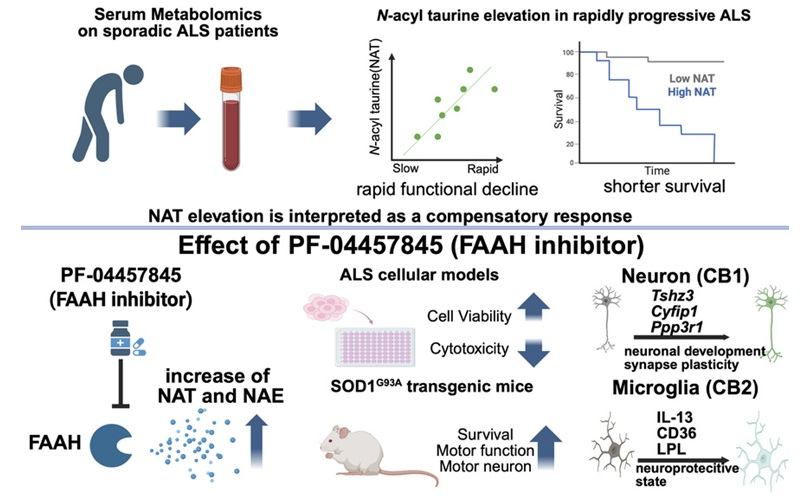
To capture systemic metabolic changes, the team profiled 867 metabolites in blood samples from individuals with fast- and slow-progressing ALS, as well as from healthy volunteers. NATs, which are part of the extended endocannabinoid system, were elevated in rapidly progressive ALS, and the highest levels were associated with shorter survival. The researchers suggested that this increase may reflect an endogenous protective response, raising the possibility that pharmacologically boosting NATs could help protect neurons.
To explore whether this metabolic signal could point to therapeutic strategies, the investigators screened 29 compounds in motor neurons derived from induced pluripotent stem (iPS) cells from ALS patients. PF-04457845 reduced degenerative changes, limited cellular damage, and preserved neurites in vitro. The compound was then administered to eight-week-old ALS model mice to assess its effects in vivo.
Treatment extended median survival to 138 days, compared with 129.5 days in untreated mice, while improving strength and movement and better preserving spinal cord motor neurons. Healthy mice showed no measurable effect. Gene-expression analyses indicated that the drug shifted microglia toward a supportive, anti-inflammatory state and directly altered genes involved in neuronal growth and function.
With collaborators from Aichi Medical University and Juntendo University, the researchers now plan larger patient studies to evaluate NATs as biomarkers of disease severity and treatment response, while continuing to assess PF-04457845 and other agents that target NATs and the endocannabinoid system.
“Through our reverse translational approach, beginning with patient blood analysis, we identified metabolic changes throughout the body. Based on these findings, we explored new treatments and demonstrated that the potential drug is effective in both patient-derived iPS cells and animal models,” said Professor Masahisa Katsuno, Nagoya University Graduate School of Medicine.
Related Links
Nagoya University