Computational Tool Identifies Central Asthma Genes for Target Discovery
Posted on 25 Aug 2026
Asthma arises from complex genetic interactions in which numerous variants influence interconnected gene-expression networks, making causal drivers difficult to identify. Conventional genome-wide association studies often highlight genes located near associated variants rather than the central effectors that directly shape disease biology. Distinguishing these disease-proximal genes therefore remains a major challenge for translating genetic findings into therapeutic targets.
Researchers at the University of Chicago, working with Columbia University, developed a software tool called DANDELION to prioritize disease-proximal genes (DPGs) in asthma. The method centers on trans-gene regulation, in which genetic variants alter the expression of one gene, which in turn influences other genes across a broader regulatory network. By tracing these downstream effects, DANDELION moves beyond the genes located closest to associated variants and instead identifies potential central disease drivers, including genes on entirely different chromosomes that may play a more direct role in asthma biology.
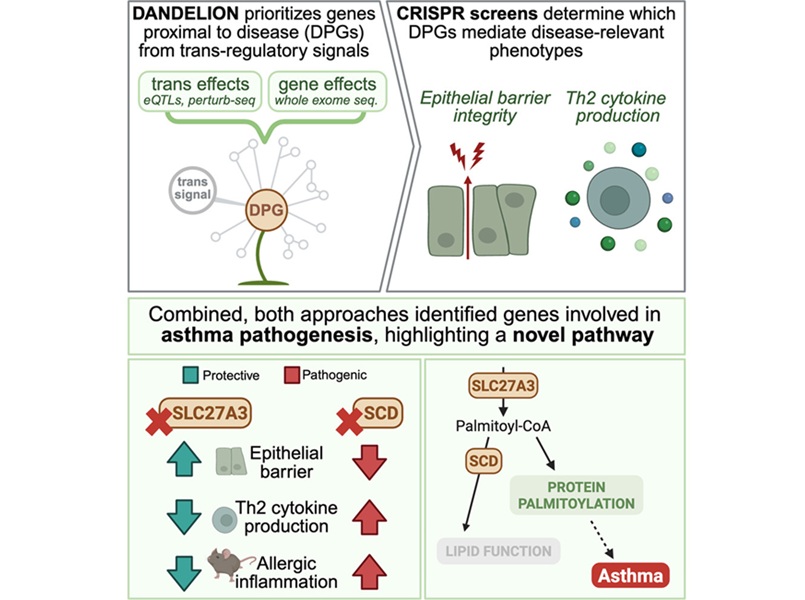
Using human transcriptome resources and the UK Biobank, which includes data from more than 500,000 volunteers, the team applied DANDELION to asthma and nominated 21 candidate genes, 19 of which had not been found by traditional methods. Functional validation combined CRISPR gene‑editing screens across airway epithelial and immune T cells with in vivo models. Analysis of a large human cohort approaching half a million individuals further examined how natural variation in these genes relates to asthma.
The screens showed that knocking out SLC27A3 protected against asthma-related phenotypes in both airway epithelial and T cells, whereas loss of SCD produced detrimental effects. Patient lung-cell expression patterns supported these findings, with SLC27A3 levels increased and SCD levels decreased in severe asthma. Both genes converge on pathways involving fatty acid metabolism and protein palmitoylation, and reducing palmitoylation through SLC27A3 inactivation dampened immune and inflammatory processes in the lung epithelium.
These effects were also confirmed in vivo. In mouse models, SLC27A3 knockout protected against allergy-induced lung inflammation, while SCD knockout increased susceptibility. The findings, published in Cell, involved contributions from the University of Arizona and the First Affiliated Hospital of Kunming Medical University in China.
The researchers indicated plans to evaluate DANDELION in additional complex conditions such as inflammatory bowel disease and type 2 diabetes, noting its potential to help prioritize true disease drivers for further study.
"All these existing tools assume that the actual disease genes are always going to be very close to the disease variants, but when you search for clues around that variant, you don’t always find much," said Xuanyao Liu, Ph.D., Assistant Professor of Medicine and Human Genetics, University of Chicago.
"My lab has been working on the role of protein palmitoylation in immune signaling. We know many immune signaling pathways are regulated by palmitoylation, but I am still amazed by the finding that disrupting a lipid metabolic protein, SLC27A3, could offer protection in asthma models at least in part via affecting protein palmitoylation," said Hening Lin, Ph.D., James and Karen Frank Family Professor of Medicine and Professor of Chemistry, University of Chicago.
Related Links
University of Chicago