Preoperative Blood Test Predicts Colorectal Cancer Recurrence and Metastasis
Posted on 23 Jul 2026
Cancer cells require large amounts of nutrients to grow and proliferate, and amino acids support key processes including protein formation, energy production, and DNA synthesis. Colorectal cancer is marked by particularly pronounced changes in amino acid metabolism, suggesting that circulating serum amino acids may reflect systemic metabolic reprogramming as disease advances. However, how these amino acids interact and change together has remained underexplored. New findings demonstrate that modeling interactions among circulating amino acids from a single preoperative sample can improve prediction of colorectal cancer outcomes.
Korea Advanced Institute of Science & Technology (KAIST; Daejeon, Korea), in collaboration with Gangnam Severance Hospital and Asan Medical Center, developed a framework that analyzes networks of circulating amino acids to reflect the body’s metabolic state. Using fluorine-19 nuclear magnetic resonance (19F NMR) spectroscopy after fluorine labeling, the method simultaneously quantifies 18 amino acids from a small serum sample. Network-derived features are then incorporated into machine-learning models to estimate the risk of recurrence or metastasis from a single preoperative blood draw.
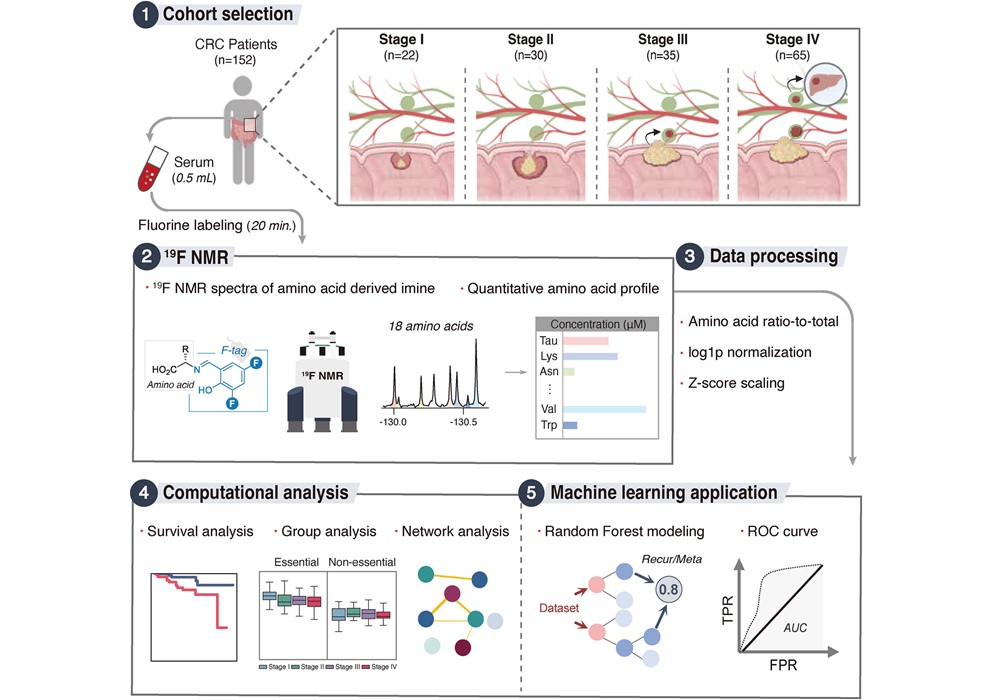
The investigators observed that the circulating amino acid network undergoes stage-dependent remodeling consistent with systemic metabolic reprogramming. As colorectal cancer progressed, the relative proportion of branched-chain amino acids such as valine and leucine, which play important roles in muscle and energy metabolism, declined. Meanwhile, glycine and serine, which cancer cells use for DNA synthesis and rapid proliferation, increased. This shift suggests that amino acid utilization throughout the body changes as the disease advances.
A glycine-centered interaction pattern also emerged. Glycine’s relative abundance in blood rose despite its active use by rapidly proliferating tumor cells, providing further evidence of broader systemic changes in amino acid utilization.
Model development incorporated pairwise interaction features and nested cross-validation. A correlation-based model outperformed a carcinoembryonic antigen (CEA)-only comparator, while a combined model integrating CEA, individual amino acid levels, and interaction-derived features achieved the highest overall predictive performance.
The study is the first to show that the interaction network among circulating amino acids could serve as a blood-based metabolic biomarker, suggesting that evaluating how amino acids change together may provide a more informative picture of cancer progression than measuring levels alone.
The findings were published online in Advanced Science on June 9, 2026, in a paper titled “Circulating Amino Acid Network Remodeling Reveals Systemic Metabolic Reprogramming Predictive of Colorectal Cancer Recurrence and Metastasis.”
Related Links
KAIST