Blood-Based Gene Expression Test Detects Early Pancreatic Cancer
Posted on 20 Jul 2026
Pancreatic cancer remains difficult to detect at a curable stage and is associated with poor survival outcomes. In Japan, the five-year relative survival rate is 8.5%, while early-stage disease accounts for only 2–3% of diagnoses because timely detection remains challenging. Noninvasive blood-based biomarkers are therefore a priority for improving outcomes. A new study shows that a whole-blood gene expression test identified most stage 0–I pancreatic cancers.
Researchers at Kanazawa University developed Panregza, a blood-based diagnostic that combines peripheral whole-blood gene expression patterns with the serum tumor marker carbohydrate antigen 19-9 (CA19-9). The assay was previously validated mainly in advanced pancreatic cancer, leaving its utility for early disease uncertain. The current analysis addresses that gap.
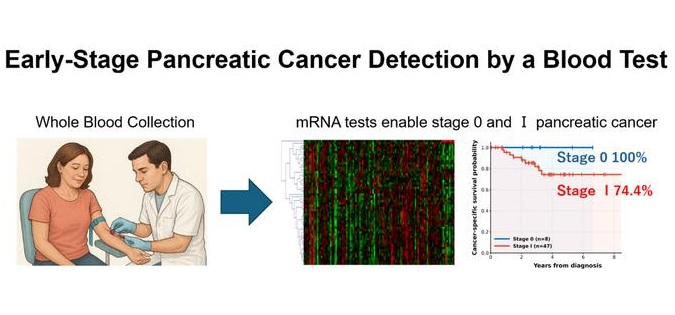
The approach interrogates a panel of 56 gene probes to detect disease-associated transcriptional changes in peripheral blood. Researchers previously observed that gene expression in peripheral blood mononuclear cells (PBMCs) differs between patients with pancreatic cancer and healthy individuals, and have assumed that pancreatic cancer cells induce changes by influencing these immune cells. Building on that observation, Panregza applies whole-blood messenger RNA (mRNA) signatures together with CA19-9; the kit is currently marketed by Cubix Inc.
In a single-center case–control diagnostic accuracy study, the team analyzed 10 patients with stage 0–I pancreatic cancer, representing 4% of 253 cases, and compared them with 104 healthy individuals. Three diagnostic approaches were evaluated: peripheral whole-blood gene expression, CA19-9 alone, and the combined Panregza test.
Using the 56-gene panel, gene expression analysis identified 9 of 10 early-stage cases (90%), whereas CA19-9 detected 1 of 10 (10%). The combined Panregza test achieved 60% sensitivity and 93.3% specificity. Published in Scientific Reports in 2026, the study indicates that abnormalities in whole-blood gene expression are detectable even when CA19-9 is normal, suggesting early detection may not depend on tumor volume. At the Innovative Research and Development Center for Pancreatic Cancer at Kanazawa University Hospital, five-year survival is 100% for stage 0 and 74.4% for stage I, underscoring the importance of timely diagnosis.
Related Links
Kanazawa University



 Assay.jpg)