AI Pathology Tool Predicts Immunotherapy Response in Rare Cancers
Posted on 02 Jul 2026
Immunotherapy has transformed care for select malignancies, yet predicting which patients with rare cancers are most likely to benefit remains challenging. Clinicians often have only limited biomarkers to guide treatment decisions, while routine histologic features can be time-consuming to quantify at scale. More efficient and objective measures derived from standard tumor specimens could therefore support both clinical decision-making and research. New findings now demonstrate that an artificial intelligence (AI) approach applied to tumor biopsies can stratify immunotherapy response in patients with rare cancers.
Researchers at the University of Texas MD Anderson Cancer Center (Houston, TX, USA) evaluated an AI-guided pathology approach for assessing immunotherapy response in patients with rare cancers. The method focuses on the tumor microenvironment by quantifying immune cell infiltration within the tumor before treatment and tracking how these patterns change during therapy. It also measures tumor content on the same slides. According to the investigators, the analysis builds on earlier work identifying tumor microenvironment features associated with response, even when conventional predictive markers are absent.
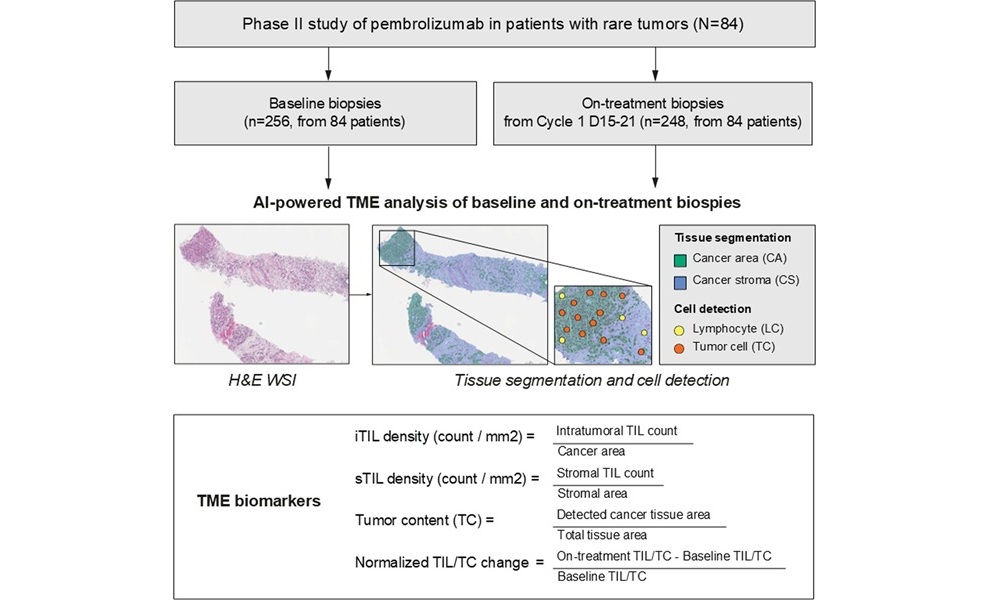
The technology uses routinely collected pathology slides to automate the labor-intensive process of enumerating immune and cancer cells. By generating these measurements rapidly and longitudinally across multiple biopsies from the same patient, the method provides a standardized readout of dynamic tumor–immune interactions. This enables evaluation of individual signals, such as increased immune infiltration or decreased tumor content, as well as combined patterns over time using whole-slide specimens already integrated into clinical workflows.
In the current study, increases in tumor immune infiltration and decreases in tumor content were each associated with clinical benefit. However, the prognostic value was strongest when both signals were combined, reflecting an active immune response alongside reduced tumor burden. Patients with this favorable combined pattern had a 64% lower risk of disease progression or death and markedly longer median survival than those without these markers, at 42 months versus 10 months.
The article, titled “Artificial intelligence-guided analysis of the tumor microenvironment predicts response to pembrolizumab in rare tumors,” was published in the Journal for ImmunoTherapy of Cancer. The authors note that broader validation in larger populations is needed before the approach can be used to inform treatment decisions in routine practice.
“AI-based pathology has the potential to provide clinicians with useful information on both the tumor and its surrounding microenvironment, helping to guide personalized treatment decisions for patients receiving immunotherapy,” said Aung Naing, M.D., professor of Investigational Cancer Therapeutics at The University of Texas MD Anderson Cancer Center.
“While this AI-powered approach needs validation, this is an exciting step forward because it shows that meaningful insights can be extracted from routine pathology samples across a diverse group of rare cancers,” said Naing.
Related Links
University of Texas MD Anderson Cancer Center