New Findings Clarify Molecular Drivers of Rare Small Intestinal Cancer
Posted on 16 Jun 2026
Small intestinal cancer is rare, accounting for about 3% of gastrointestinal malignancies, and its molecular drivers remain less well defined than those of colorectal cancer. While many small intestinal adenomas harbor APC mutations that activate the Wnt pathway, most adenocarcinomas do not, leaving important questions about alternative disease mechanisms. Clarifying these oncogenic drivers could improve lesion classification and guide molecular testing. New findings show that recurrent COPA mutations may drive key cancer-related signaling in small intestinal tumors.
At Keio University School of Medicine (Tokyo, Japan), investigators identified recurrent deletions in the COPA gene as a driver of small intestinal tumorigenesis. COPA had not previously been linked to cancer and encodes a component of the coatomer complex responsible for protein transport between the Golgi apparatus and endoplasmic reticulum. The team first examined a morphologically distinct subset of protruding small intestinal adenomas with branched glands from three patients, then expanded their analysis to a broader cohort of adenomas and adenocarcinomas.
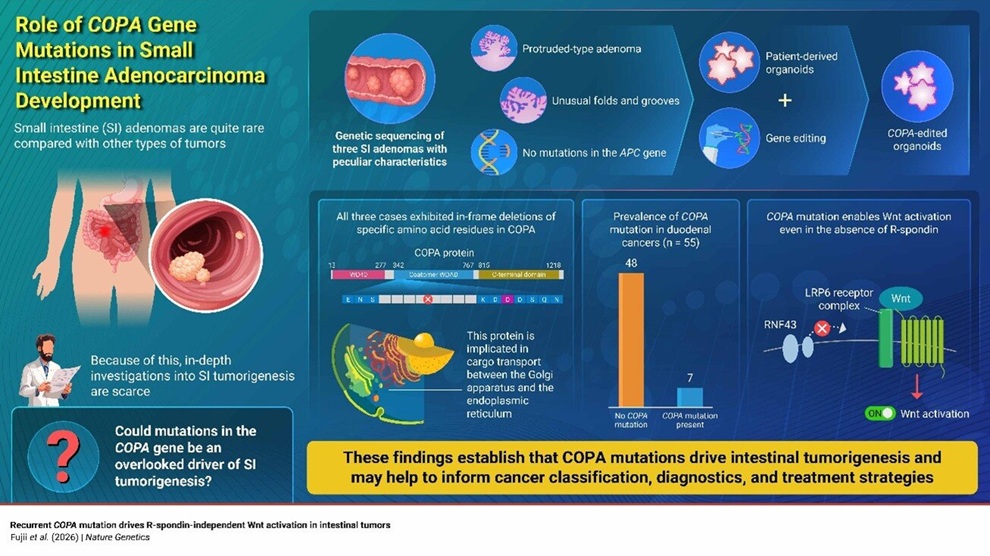
Targeted sequencing of protein-coding regions in the initial tumors revealed recurrent deletions in a specific region of COPA. Screening across additional cases detected similar COPA mutations in a fraction of tumors, and none of these COPA-mutant cases carried APC or other known Wnt pathway gene mutations. These data support COPA alteration as an independent initiating route for small intestinal tumor development.
Functional studies used patient-derived small intestinal organoids and gene editing to introduce the same COPA mutations into healthy organoids. Both approaches converged on a shared phenotype: COPA mutations activated Wnt signaling while bypassing the normal requirement for the growth factors R-spondin and Noggin. This mechanism offers a plausible explanation for why APC mutations are common in adenomas but relatively rare in adenocarcinomas, pointing to multiple biological paths to malignancy in the small intestine.
The work highlights potential implications for tumor classification, noting relevance to references such as the World Health Organization classification of digestive system tumors. The study, “Recurrent COPA mutation drives R-spondin-independent Wnt activation in intestinal tumors,” was published in Nature Genetics on June 12, 2026. The researchers indicated that further investigation of COPA mutations may inform new diagnostic and treatment strategies for intestinal cancers lacking APC mutations.
“Scientists have exhaustively hunted down genes responsible for cancer, so this was a shocking new find,” said Masayuki Fujii, Associate Professor, Keio University School of Medicine.
“The current discovery could inform catalogs like the WHO classification of digestive system tumors, which doctors widely use to identify tumor types in patients,” addedFujii.
Related Links
Keio University School of Medicine