Simple Blood-Based Cholesterol Efflux Assay Identifies High-Risk Coronary Plaque Features
Posted on 12 Jun 2026
Unstable coronary plaques are difficult to identify before they trigger acute cardiovascular events. Standard high-density lipoprotein (HDL) measurements do not always capture how well HDL particles function in the body, creating a need for practical biomarkers that better reflect HDL activity and improve risk stratification. Cholesterol efflux capacity (CEC), a key measure of HDL function, assesses how effectively HDL removes excess cholesterol from cells for transport to the liver and metabolism. However, conventional CEC testing is often complex. A new study shows that a simple blood-based CEC assessment can identify high-risk plaque features in patients.
A new study shows that a simple blood-based assessment of CEC can identify high-risk plaque characteristics in patients. Developed by researchers at Institute of Science Tokyo, the immobilized liposome-bound gel beads (ILG) method quantifies CEC using patient samples and is designed to reduce the complexity that has limited broader use of conventional CEC testing. The approach is described as simple and highly accurate.
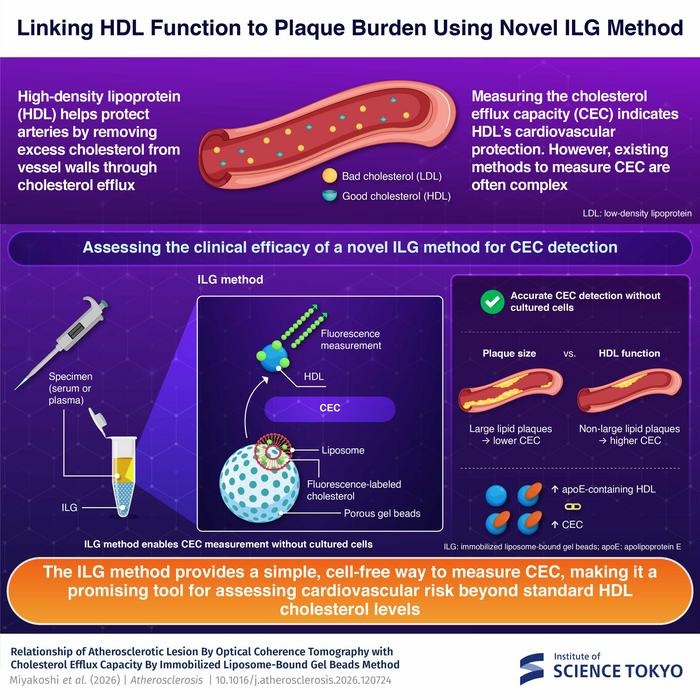
In collaboration with the Department of Cardiovascular Medicine at the same institution, investigators evaluated the clinical utility of ILG by analyzing samples from 61 patients who had undergone catheter examinations in the Department of Cardiology. CEC values measured by ILG were compared with coronary plaque features characterized by optical coherence tomography (OCT), which can visualize coronary artery plaques in detail. The analysis examined whether impaired HDL function aligns with high-risk plaque morphology.
Patients with large lipid-rich plaques, which are widely recognized as vulnerable lesions, had significantly lower CEC values, while those without large lipid-rich plaques showed higher CEC. Higher CEC values were also associated with HDL particles containing apolipoprotein E. Together, these observations suggest that reduced cholesterol removal capacity may be linked to unstable plaques that can trigger serious cardiovascular events.
Details of the experimental study were published online in Atherosclerosis on April 2, 2026, under the title “Relationship of atherosclerotic lesion by optical coherence tomography with cholesterol efflux capacity by immobilized liposome-bound gel beads method.” The work involved teams from the Department of Clinical Bioanalysis and Molecular Biology and the Department of Cardiovascular Medicine at Institute of Science Tokyo.
Because detecting large lipid-rich plaques in living patients typically requires invasive procedures such as cardiac catheterization, the authors note that an accessible functional biomarker could support risk prediction and guide preventive strategies. They indicate that the ILG method may help overcome barriers that have limited routine CEC testing by enabling practical and reliable measurements. They also note potential use in the earlier detection of coronary artery disease risk and in monitoring after cardiovascular events.
“By simplifying the measurement of CEC, we aimed to make this biomarker more accessible for clinical use,” said Ryunosuke Ohkawa, Professor, Department of Clinical Bioanalysis and Molecular Biology, Institute of Science Tokyo.
Related Links
Institute of Science Tokyo