Microfluidic Single-Cell Assay Predicts Breast Cancer Risk
Posted on 27 Apr 2026
Risk stratification for breast cancer remains imprecise, as population-based models and breast density can over- or underestimate individual risk, potentially leading to over- or under-screening. There is also no non-genetic test to identify higher-risk women before disease emerges. To address this gap, researchers have introduced a single-cell, microfluidic, and machine-learning approach that quantifies breast cancer susceptibility directly from a woman’s epithelial cells.
City of Hope (Duarte, CA, USA), in collaboration with the University of California (Berkeley, CA, USA), developed MechanoAge, a microfluidic platform that assesses breast cancer risk at the cellular level. The system squeezes individual breast epithelial cells to evaluate how they deform and recover under stress, then uses machine learning to translate these biophysical responses into a personalized risk score. The work is detailed in eBioMedicine (2026).
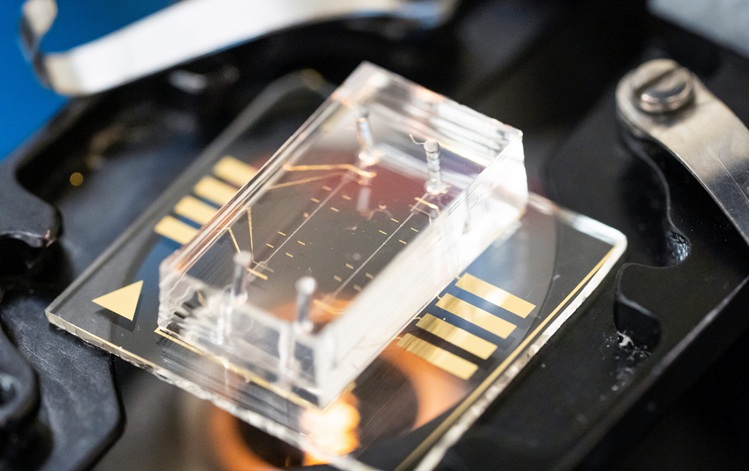
The platform operates using mechano-node pore sensing (Mechano-NPS), which measures an electrical current across a liquid-filled microchannel. As cells transit the channel, they perturb the signal, enabling measurement of size, shape, and recovery kinetics. Narrow constrictions apply mechanical strain so recovery time serves as a readout of viscoelastic properties, and the algorithm quantifies a “mechanical age” that the investigators associated with increased susceptibility.
In comparative analyses, cells from older women were stiffer and took longer to return to baseline than cells from younger women. Surprisingly, a subset of younger women carrying high-risk genetic mutations exhibited cell behaviors resembling those of older women. After refinement, the algorithm identified individuals with known genetic risk and was applied to cells from healthy women, women with a family history, and tissue from the unaffected breast of women with cancer in the contralateral breast.
According to the authors, more than 90% of women lack a known genetic predisposition to breast cancer, underscoring the need for individualized, biology-based risk tools. The MechanoAge electronics use simple components that the team indicated would be easy and affordable to replicate on a large scale. The study, which reflects more than 12 years of cross-disciplinary collaboration, appears in eBioMedicine (2026).
“Our team isn't the first to measure the mechanical properties of cells; however, other approaches require advanced imaging technology that's expensive, cumbersome, and has limited availability. In contrast, MechanoAge uses computer chips that are simpler than an Apple Watch and 'Radio Shack parts' that are cheap and easy to assemble, potentially making the device highly scalable,” said Lydia Sohn, Ph.D., the Almy C. Maynard and Agnes Offield Maynard Chair in Mechanical Engineering at UC Berkeley.
“With accuracy, we were able to figure out which women were at high risk of breast cancer and which women didn't seem to be,” said Mark LaBarge, Ph.D., a professor in the Department of Population Sciences at City of Hope.
Related Links
City of Hope
UC Berkeley