Rapid Color Test Stratifies Virulent and Resistant Staph Strains
Posted on 18 Apr 2026
Staphylococcus aureus (golden staph) remains a leading cause of infection-related mortality worldwide, responsible for more than a million deaths each year. Rapidly distinguishing highly virulent or antibiotic-resistant strains is critical for timely therapy but remains challenging in routine settings. Faster front-end triage could help laboratories flag high-risk cases and support care decisions. A new study shows a rapid color-changing test can stratify golden staph strains by virulence and likely resistance within a streamlined workflow.
RMIT University (Melbourne, Australia) researchers developed a rapid color-changing test, described in their Small paper as a nanozyme aptasensor array, to differentiate Staphylococcus aureus strains. The approach is intended as a low-cost screening tool that complements culture and polymerase chain reaction (PCR) testing rather than replacing them. The platform is positioned to help separate potentially high-risk strains from others and guide next diagnostic steps.
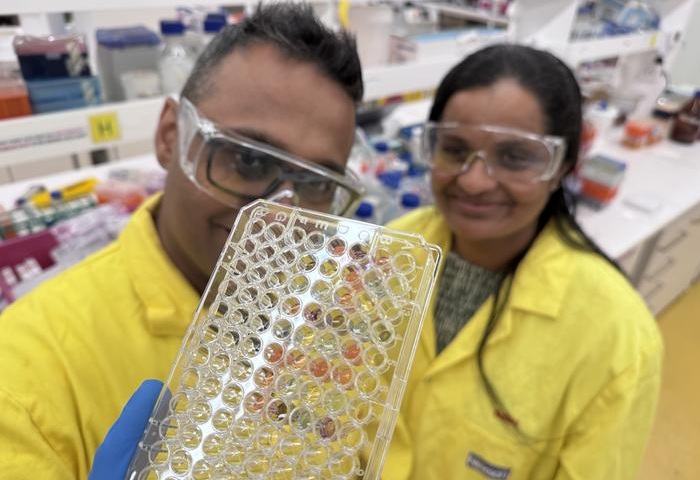
The technology couples tiny gold particles that act as artificial enzymes (nanozymes) with short DNA molecular binders to produce color “fingerprints” unique to each strain. These fingerprints indicate whether a strain carries markers associated with increased virulence and whether it is likely to have antibiotic resistance. By resolving subtle biological differences without prior surface knowledge, the method emphasizes pattern recognition over single-target detection.
To assess performance in realistic matrices, the team tested the sensor in simulated wound fluid spiked with different golden staph strains. The array generated comparable strain fingerprints in the simulated wound environment and, in some cases, produced stronger and faster responses than in simpler conditions. The researchers note the platform could be modified to detect dangerous strains of other pathogens.
The study, “Nanozyme Aptasensor Array for Predictive Sensing of Virulent and Antibiotic-Resistant Staphylococcus aureus strains,” was published in Small on February 11, 2026. The work was led by RMIT University with collaborators from the University of Massachusetts Amherst (U.S.), the National Institute of Pharmaceutical Education and Research (India), and Western Sydney University. Nano-biotechnology company Nexsen is partnering with the Sir Ian Potter NanoBioSensing Facility across clinical, veterinary, and biosecurity diagnosis.
“Speed matters when you’re dealing with serious bacterial infections, and today’s gold-standard tests take time, specialist infrastructure or both. The rapid test gives clinicians an early, evidence-informed ‘heads-up’ if an infection may be more aggressive or harder to treat,” said Professor Rajesh Ramanathan, from the Sir Ian Potter NanoBioSensing Facility and NanoBiotechnology Research Laboratory within RMIT’s School of Science.
“Our team continues to generate new sensing concepts, and working closely with industry means we can move faster toward real world impact,” said Vipul Bansal, Founding Director of the Sir Ian Potter NanoBioSensing Facility.
Related LInks
Sir Ian Potter NanoBioSensing Facility