AI-Enabled POC Test Quantifies Multiple Cardiac Biomarkers
Posted on 10 Apr 2026
Cardiovascular diseases are a leading cause of death, responsible for nearly 20 million deaths each year. Timely triage of myocardial infarction and heart failure hinges on rapid cardiac biomarker measurement, yet multiplexed testing is often confined to centralized analyzers. This limits access in decentralized and time-critical settings. A new study shows an artificial intelligence-enabled portable sensor can rapidly quantify multiple cardiac biomarkers in a single test.
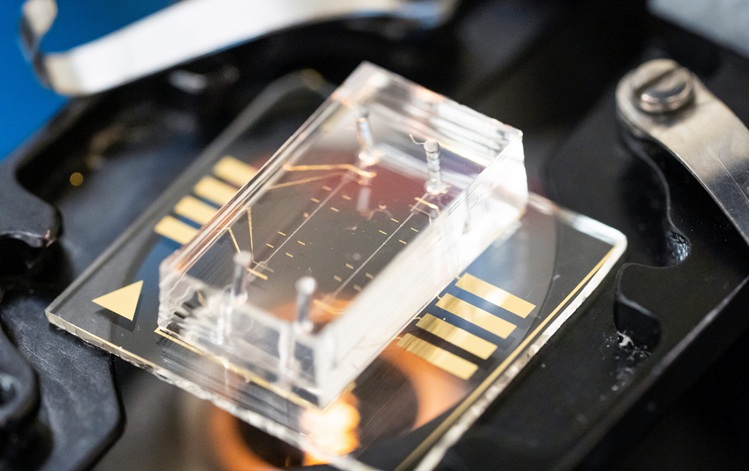
UCLA researchers have developed a dual-mode multiplexed vertical flow assay (xVFA) platform that measures three cardiac biomarkers—troponin I (cTnI), CK-MB, and NT-proBNP—using a compact, point-of-care format. The system integrates two complementary optical modalities, colorimetry and chemiluminescence, within a single paper-based cartridge. Neural network-based analysis interprets the multiplexed signals to deliver quantitative results designed to support rapid clinical decision-making.
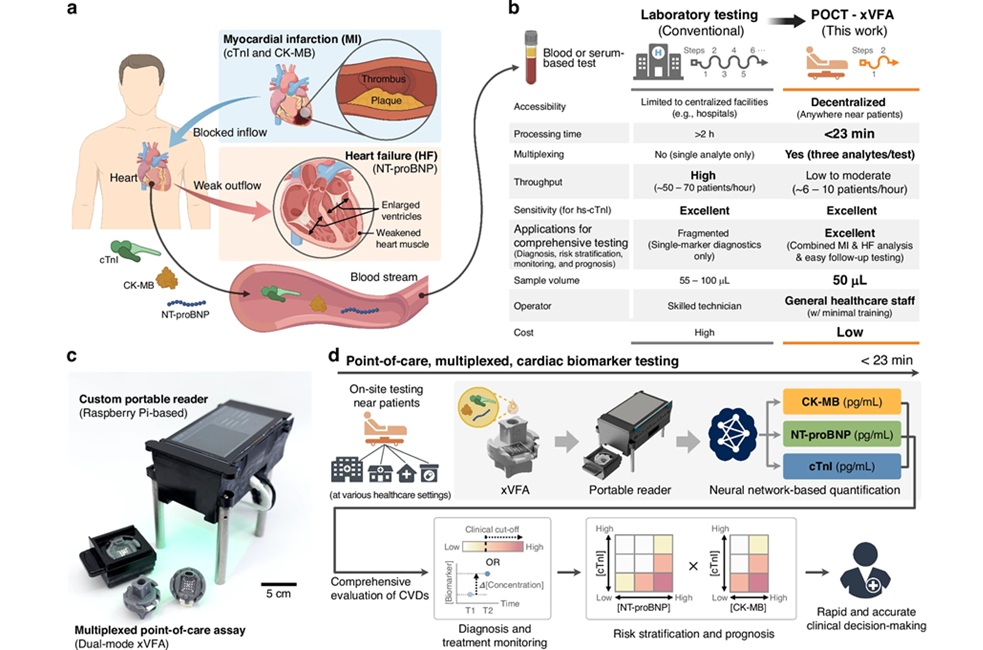
The device workflow uses 50 µL of serum loaded into the multiplexed cartridge, enabling operation by minimally trained medical personnel. Following the assay steps, the cartridge produces colorimetric and chemiluminescent outputs that are captured by a portable optical reader. The platform provides quantitative results for all three biomarkers in 23 minutes from a single test.
Colorimetric sensing in the xVFA supports reliable quantification at higher analyte concentrations, while chemiluminescence offers high sensitivity at very low levels. By uniting these modalities, the assay achieves accurate multiplexed detection across clinically relevant concentration ranges and a broader dynamic range than conventional rapid tests. According to the study, this approach enables robust quantification performance comparable to standard laboratory-based analyzers.
Investigators validated the system using patient serum samples, demonstrating strong agreement with conventional laboratory measurements. Neural network models were trained and blindly tested to quantify cTnI, CK-MB, and NT-proBNP, yielding consistent performance in this evaluation. The work, published in Light: Science & Applications on April 8, 2026, outlines how combining multiplexed biosensing, portable instrumentation, and AI-driven analysis can help bridge centralized and point-of-care testing.
“Our goal was to bridge the gap between centralized laboratory diagnostics and point-of-care testing. By combining dual-mode optical sensing with AI, we can achieve sensitive and multiplexed biomarker detection using a compact and accessible diagnostic platform,” said Aydogan Ozcan, Chancellor’s Professor at UCLA and corresponding author of the study.
Related Links
UCLA Samueli School of Engineering