AI Tool Predicts Patient-Specific Chemotherapy Benefit in Breast Cancer
Posted on 01 Apr 2026
Selecting adjuvant chemotherapy for early-stage breast cancer is typically guided by recurrence risk and population-level averages rather than patient-specific benefit. However, existing clinicopathologic and genomic tools have limited accuracy and scope, which can lead to both overtreatment and undertreatment. To address this gap, a newly launched artificial intelligence test estimates individualized chemotherapy benefit at the patient level, offering more precise support for treatment planning.
Ataraxis AI has introduced Ataraxis Breast CTX, a predictive capability within the Ataraxis Breast platform designed to quantify chemotherapy benefit for individual patients. The system integrates digitized hematoxylin and eosin (H&E) pathology slides with clinical data to generate patient-specific prognostic and predictive outputs. It models outcomes under two strategies—adjuvant chemotherapy versus no adjuvant chemotherapy—allowing clinicians to directly compare expected benefit and better inform decision-making.
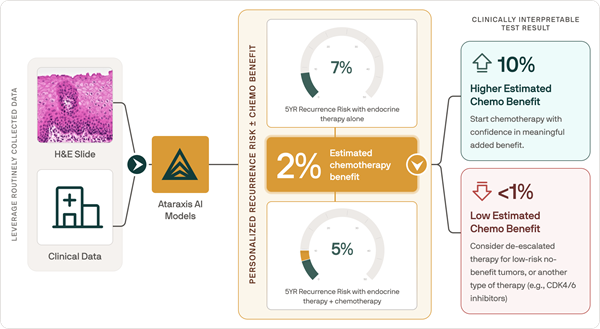
These predictions are powered by Ataraxis Tau, a causal inference layer engineered to address treatment selection bias and confounding common in retrospective and real-world datasets. By separating baseline prognosis from treatment effect, Tau enables a shift from population-based estimates to individualized assessments of therapy benefit, forming the foundation for a new generation of predictive tests.
The CTX capability was developed using multimodal data from more than 10,000 breast cancer patients worldwide and was independently validated across observational real‑world studies and randomized controlled trials. Since launch, it has been adopted by National Cancer Institute (NCI)–designated cancer centers and community clinics across the United States. Within the broader platform, Ataraxis Breast RISK is an artificial intelligence–based prognostic test validated for use across all molecular subtypes, including HER2‑positive and triple‑negative breast cancer, extending recurrence risk assessment to groups often not addressed by legacy tools. Together, RISK and CTX separate prognosis from predicted treatment effect to support more individualized treatment planning.
“For too long, chemotherapy decisions in breast cancer have been based on how a treatment works on average, not whether it will actually benefit the specific person sitting across from you. Ataraxis Breast CTX was built to change that. It is a first-in-class test, not just best-in-class, because no tool has estimated individualized chemotherapy benefit this way before. At its core is Ataraxis Tau, our causal AI layer, which is what makes this possible. CTX is the first in what we’re building as a new generation of predictive tools, each one bringing us closer to our vision of fully personalized cancer care,” said Jan Witowski, MD, PhD, CEO & co‑founder, Ataraxis AI.
Related Links
Ataraxis AI