AI Sensor Detects Neurological Disorders Using Single Saliva Drop
Posted on 10 Mar 2026
Neurological disorders such as Parkinson’s disease and Alzheimer’s disease often develop gradually and present subtle symptoms in their early stages. Because early signs are frequently vague or atypical, diagnosis is often delayed until the disease has progressed significantly. Current diagnostic tools, such as brain imaging and cerebrospinal fluid testing, can provide useful information but are costly and invasive, limiting their use for routine screening. Researchers have now developed a new saliva-based diagnostic platform designed to detect neurological disorders earlier using artificial intelligence (AI) and molecular sensing.
The system, developed by scientists at Korea University (Seoul, South Korea), uses surface-enhanced Raman scattering (SERS), an analytical technique that detects molecular signatures generated when light interacts with biological molecules. To improve detection sensitivity, the researchers engineered a specialized sensor structure and applied a method called galvanic molecular entrapment (GME). This technique enhances the capture and detection of extremely small amounts of protein signals present in saliva.
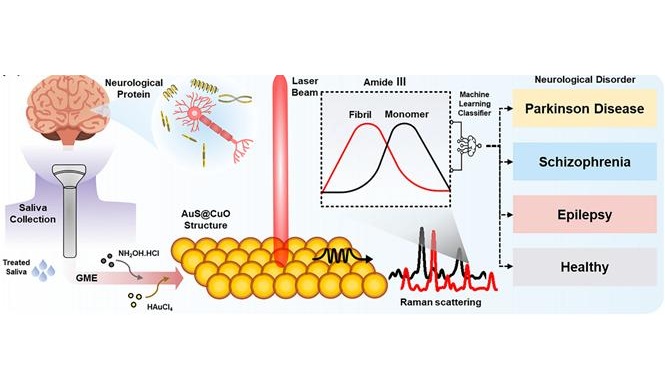
Using the sensor platform, researchers analyzed key neuroproteins associated with neurological diseases, including amyloid-beta 42 (Aβ42) and tau proteins. The team observed that the spectral signals produced by these proteins changed depending on their structural configuration. Based on these molecular signatures, the researchers developed analytical indicators capable of identifying protein alterations linked to neurological disorders.
In research published in Advanced Materials, the system was tested on 67 clinical saliva samples, and the AI model successfully distinguished among epilepsy, schizophrenia, and Parkinson’s disease with an overall diagnostic accuracy of 93.94 percent. Because the platform relies on saliva samples rather than invasive testing methods, it could potentially be used for rapid screening in clinical or community settings. The integration of AI with molecular sensing also enables automated interpretation of complex protein signals. Researchers suggest that the approach may support early detection of neurological disorders and could eventually contribute to the discovery of new biomarkers for brain diseases.
“This study presents a point-of-care diagnostic platform that enables non-invasive early screening of neurological disorders based on structural changes in saliva proteins,” said Professor Jung Ho-sang, who led the research team. “In the future, it may also be applied to the diagnosis of various neurological diseases and to the discovery of new biomarkers.”
Related Links:
Korea University





.jpg)