MicroRNA-Based Method Predicts CKD and Cardiovascular Risk
Posted on 03 Mar 2026
Chronic kidney disease (CKD) affects more than 850 million people worldwide and is a rapidly growing public health threat. Although it progressively damages kidney function, many patients die prematurely from cardiovascular complications before ever requiring dialysis or transplantation. Disease progression is unpredictable, and current monitoring tools, such as proteinuria and glomerular filtration rate, mainly reflect existing damage rather than future risk. Researchers have now identified tiny RNA molecules in blood that can predict both kidney function decline and cardiovascular events in patients with CKD.
Researchers at the Institute of Science Tokyo (Tokyo, Japan) investigated whether microRNAs (miRNAs) contained within circulating extracellular vesicles (cEVs) could serve as minimally invasive predictive biomarkers. Extracellular vesicles are nanoscale, membrane-bound particles released by cells that carry biologically active molecules throughout the body. Because they protect their cargo from degradation, they provide stable molecular signals reflecting systemic disease processes. The researchers first analyzed blood samples from 36 patients and identified 23 miRNAs significantly depleted in advanced CKD.
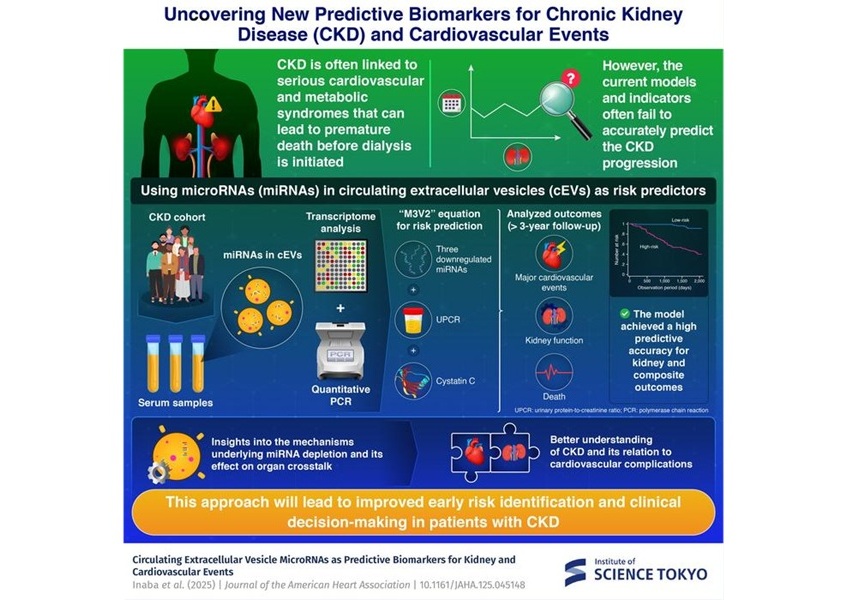
Using statistical modeling and machine learning, the team narrowed the findings to three key miRNAs most strongly associated with kidney decline. These biomarkers were validated in a larger cohort of 234 CKD patients. The researchers combined the three miRNAs with cystatin C and urinary protein-to-creatinine ratio to develop an integrated risk score known as the M3V2 equation. The findings of the long-term follow-up, published in the Journal of the American Heart Association, showed that the M3V2 model significantly outperformed conventional clinical markers in predicting both kidney decline and major cardiovascular events. Its predictive value was consistent regardless of CKD cause or existing cardiovascular disease.
The findings highlight the role of extracellular vesicle miRNAs in linking kidney dysfunction with cardiovascular complications. By identifying high-risk patients earlier, clinicians may be able to tailor interventions more effectively and prevent unnecessary complications or premature death. Future research will focus on refining the model and integrating it into clinical practice, advancing personalized medicine strategies for individuals living with CKD.
Related Links:
Institute of Science Tokyo