New Blood Test Index Offers Earlier Detection of Liver Scarring
Posted on 28 Feb 2026
Metabolic fatty liver disease is highly prevalent and often silent, yet it can progress to fibrosis, cirrhosis, and liver failure. Current first-line blood test scores frequently return indeterminate results, prompting avoidable referrals and additional follow-up testing. A new study now reports that a fibroblast activation protein-based index may enhance early identification of patients at risk of clinically significant liver damage.
Researchers at the Centenary Institute (Sydney, Australia) have developed a diagnostic tool, the FAP-Index, to improve triage of individuals with metabolic fatty liver disease who are at heightened risk of advanced liver fibrosis. The tool is intended to address uncertainty that often arises when existing first-line risk scores yield indeterminate results. It is positioned for early use in the care pathway to support more targeted investigation.
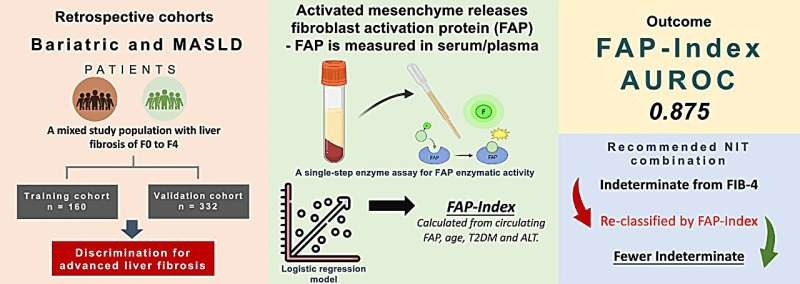
The FAP‑Index combines a simple blood test measuring fibroblast activation protein (FAP) with routinely collected clinical information to generate a more precise assessment of fibrosis risk. FAP is a biomarker directly involved in the biological processes that drive liver scarring. By incorporating a marker central to fibrogenesis, the approach differs from scoring systems that rely on indirect indicators of liver injury.
In a study published in the Journal of Gastroenterology and Hepatology, the researchers report that adding the FAP‑Index to existing first‑line blood test risk scores reduced indeterminate results by up to 70% compared with current screening tools alone. The investigators state that further studies will support the transition of the FAP-Index into routine clinical practice, with the goal of improving outcomes for the growing number of individuals living with metabolic fatty liver disease.
“Fatty liver disease is incredibly common but it’s very difficult to know who has severe liver damage. The FAP‑Index is designed to be simple, affordable and practical, so it can be used early in primary care to identify patients who genuinely need further investigation,” said Ziqi Vincent Wang, PhD student at the Centenary Institute and the University of Sydney.
“With effective therapies becoming available, there is an urgent need for better tools to test patients and more accurately detect advanced fibrosis earlier. By focusing on a protein central to liver scarring and reducing uncertain results, the FAP‑Index has the potential to ease pressure on specialist services while ensuring patients in need receive timely care,” said Professor Mark Gorrell, Laboratory Head in the Centenary Institute’s Centre for Cancer Innovations.
Related Links
Centenary Institute






 Analyzer.jpg)